

Notes For Class 12 Chemistry Janakpuri, Delhi-Biology Class 12 Notes, Chemistry Class 12 Notes, Chemistry Notes for Class 12, Chemistry Notes for Class 12, Notes For Chemistry Class 12, Chemistry lectures Class 12, Chemistry classroom lectures Class 12, best Chemistry Notes for Class 12, best Chemistry lectures for Class 12, grade 11 Chemistry Notess, Class 12 Chemistry chapter 1 Notes, Class 12 Chemistry chapter 2 Notes, Class 12 Chemistry chapter 3 Notes, Chemistry Class 12 Notes free download, Chemistry Class 12 animation Notes, animation Notes for Class 12, neet, science, coaching classes, tutors, competitive exam preparation, study center, learning center, best coaching, top coaching, online coaching, offline coaching, Study Material, Books, DVDs, NotesNotes For Class 12 Chemistry Janakpuri, Delhi-Biology Class 12 Notes, Chemistry Class 12 Notes, Chemistry Notes for Class 12, Chemistry Notes for Class 12, Notes For Chemistry Class 12, Chemistry lectures Class 12, Chemistry classroom lectures Class 12, best Chemistry Notes for Class 12, best Chemistry lectures for Class 12, grade 11 Chemistry Notess, Class 12 Chemistry chapter 1 Notes, Class 12 Chemistry chapter 2 Notes, Class 12 Chemistry chapter 3 Notes, Chemistry Class 12 Notes free download, Chemistry Class 12 animation Notes, animation Notes for Class 12, neet, science, coaching classes, tutors, competitive exam preparation, study center, learning center, best coaching, top coaching, online coaching, offline coaching, Study Material, Books, DVDs, Notes

"Chemical Kinetics"
Neet Chemistry Notes For Class 12

Available courses 29

Chemical Kinetics/class-12/theory/users/user-profile-theory-chapters-notes-study-material-online-test-papers-with-Chemical Kinetics-for-neet-entrance-exam-and-school-exams-class-11-12-science-students.jpg
Subject: Class 12 Chemistry Online Coaching For Neet Exam
Phone: +91-9868233590

Chemical Kinetics Class 12 Chemistry Notes


CHEMICAL KINETICS

Deals with rate, mechanism and factors affecting the chemical reactions.

RATE OF REACTION

It is defined as the change in concentration of a reactant or a product in a particular interval of time. The change in concentration of a substance say A is represented by Chemical-Kinetics-online-neet-coaching-delhi-tuition-class-12-science-chemistry[A]
Chemical-Kinetics-online-neet-coaching-delhi-tuition-class-12-science-chemistry[A] = [Final concentration – Initial concentration]
For a reactant : Final concentration < Initial concentration
Thus Chemical-Kinetics-online-neet-coaching-delhi-tuition-class-12-science-chemistry[A] will have negative sign
For a product : Final concentration > Initial concentration
Thus Chemical-Kinetics-online-neet-coaching-delhi-tuition-class-12-science-chemistry[A] will have positive sign
Average rate in terms of products = Chemical-Kinetics-online-neet-coaching-delhi-tuition-class-12-science-chemistry
Average rate in terms of reactants = Chemical-Kinetics-online-neet-coaching-delhi-tuition-class-12-science-chemistry
The negative sign in the expression make the rate positive.
Hence rate of a reaction is never negative.

Consider the decomposition of N2O5
Chemical-Kinetics-online-neet-coaching-delhi-tuition-class-12-science-chemistry
Instantaneous rate of a reaction
Chemical-Kinetics-online-neet-coaching-delhi-tuition-class-12-science-chemistry

Average rate of a reaction
Chemical-Kinetics-online-neet-coaching-delhi-tuition-class-12-science-chemistry
The minus sign indicates the decrease in concentration and plus sign increase in concentration. The above expressions give the average rate of reaction.

FEATURES OF THE RATE OF REACTION

  • Rate of reaction is proportional to the concentration of the reactants
  • Rate of a reaction is always a positive quantity
  • Rate of a reaction is determined by measuring the concentration of a reactant or a product as a function of time
  • Property related to concentration is selected e.g. volume, pressure, thermal or electrical conductivity, colour change, pH, etc.

UNITS OF RATE OF REACTION

Mol L–1 time–1 and for gaseous reaction atm time–1

INSTANTANEOUS RATE

As the reaction progresses the concentration of reactants keeps on falling. Hence the rate of reaction keeps on falling with time. The rate of reaction at any given instant will be given by the expression
Chemical-Kinetics-online-neet-coaching-delhi-tuition-class-12-science-chemistry
where dx is the infinitesimally small change in the concentration of x in infinitesimally small interval of time dt.

RELATION BETWEEN AVERAGE AND INSTANTANEOUS RATE

Instantaneous rate = Average rate as Dt approaches to zero
Instantaneous rate = Chemical-Kinetics-online-neet-coaching-delhi-tuition-class-12-science-chemistry

FACTORS AFFECTING THE RATE OF REACTION

  • Nature of the reactants : Reactions involving lesser bond rearrangement proceed much faster than those which involve larger bond rearrangement.
  • Temperature : In most cases the rate of reaction in a homogeneous system is approximately doubled or even tripled by an increase in temperature of 10°C.
  • Concentration of reactants : At fixed temperature and in absence of catalyst, the rate increases with increased concentration of reactants.
  • Surface area : The more the surface area, the more is the rate of reaction.
  • Positive catalyst : Increases the rate by lowering the energy of activation.
  • Presence of light : Photochemical reactions are influenced by radiations of specific wavelength.

RATE CONSTANT

Consider a reaction A + B Chemical-Kinetics-online-neet-coaching-delhi-tuition-class-12-science-chemistry Products
At a particular temperature rate is given by
Chemical-Kinetics-online-neet-coaching-delhi-tuition-class-12-science-chemistry
where k is rate constant, velocity constant or specific reaction rate.
When CA = CB = 1 then k= r (rate)

In general rate constant may be defined as the rate of the reaction when the concentration of each of the reactants is unity. It is characteristic of a particular reaction.

FACTORS INFLUENCING RATE CONSTANT

  • Temperature
Variation of rate constant with temperature is given by
Arrhenius equation : k = Chemical-Kinetics-online-neet-coaching-delhi-tuition-class-12-science-chemistry (i)
A = Constant known as frequency factor
Ea = Energy of activation. Both A and Ea are characteristic of a particular reaction.
Chemical-Kinetics-online-neet-coaching-delhi-tuition-class-12-science-chemistry = known as Boltzmann factor
Taking natural logarithm of (i)
lnk = Chemical-Kinetics-online-neet-coaching-delhi-tuition-class-12-science-chemistry (ii)
The plot of lnk Chemical-Kinetics-online-neet-coaching-delhi-tuition-class-12-science-chemistry gives a straight line
Chemical-Kinetics-online-neet-coaching-delhi-tuition-class-12-science-chemistry
Increase in temperature or decrease in the activation energy will increase the rate of reaction and exponential increase in the rate constant
At temperature T1 the equation (ii) is
lnk1 = Chemical-Kinetics-online-neet-coaching-delhi-tuition-class-12-science-chemistry (iii)
and at temperature T2
lnk2 = Chemical-Kinetics-online-neet-coaching-delhi-tuition-class-12-science-chemistry (iv)
Since A is constant for a given reaction
Subtracting (iii) from (iv)
lnk2 – lnk1 = Chemical-Kinetics-online-neet-coaching-delhi-tuition-class-12-science-chemistry
log = Chemical-Kinetics-online-neet-coaching-delhi-tuition-class-12-science-chemistry
Knowing the value of slope Ea can be calculated.

  • Catalyst : Presence of positive catalyst lowers the energy of activation and hence influences the rate constant.

UNITS OF RATE CONSTANT

Units depend upon the order of a reaction units = (Concentration)1 – n . time–1
            = (Mol L–1)1–n . time–1
where n = order of reaction
Units of rate constant for zero order reaction = Mol L–1 time–1
Units of rate constant for first order reaction = time–1

CHARACTERISTICS OF RATE CONSTANT

  • The value of k is different for different reactions.
  • At fixed temperature the value of k is constant.
  • It is independent of concentration but depends on temperature.
  • The larger the value of k the faster is the reaction and vice versa.

DIFFERENCE BETWEEN RATE CONSTANT AND RATE OF REACTION

Chemical-Kinetics-online-neet-coaching-delhi-tuition-class-12-science-chemistry

TEMPERATURE COEFFICIENT

It is the ratio of two rate constants differing by a temperature of 10 °C. Generally the temperatures are 298K & 308 K.
Temperature Coefficient = Chemical-Kinetics-online-neet-coaching-delhi-tuition-class-12-science-chemistry
The value of temperature coefficient is generally 2 and 3. In rare cases the value is 4, 5 etc.

RATE LAW EQUATION

The mathematical expression, which practically relates the rate of a chemical reaction and concentration of reactants is called rate law equation e.g. for a hypothetical reaction.
aA + bB Chemical-Kinetics-online-neet-coaching-delhi-tuition-class-12-science-chemistry   cC + dD
Rate Chemical-Kinetics-online-neet-coaching-delhi-tuition-class-12-science-chemistry [A]a [B]b.  It is law of mass action
Rate  Chemical-Kinetics-online-neet-coaching-delhi-tuition-class-12-science-chemistry [A]x [B]y    It is rate law.
If rate actually vary according to this equation practically then this is rate law equation. For decomposition of N2O5.
2N2O5 Chemical-Kinetics-online-neet-coaching-delhi-tuition-class-12-science-chemistry  2N2O4 + O2
Chemical-Kinetics-online-neet-coaching-delhi-tuition-class-12-science-chemistry and not Chemical-Kinetics-online-neet-coaching-delhi-tuition-class-12-science-chemistry
Rate law equation is, Rate = k[N2O5]
Rate law equation for reversible reaction
Chemical-Kinetics-online-neet-coaching-delhi-tuition-class-12-science-chemistry
Rate = [ Rate of forward reaction ] - [ Rate of backward reaction ]
Rate law equation involving side reactions
Chemical-Kinetics-online-neet-coaching-delhi-tuition-class-12-science-chemistry
Rate of formation of Chemical-Kinetics-online-neet-coaching-delhi-tuition-class-12-science-chemistry
Rate = Chemical-Kinetics-online-neet-coaching-delhi-tuition-class-12-science-chemistry

ORDER OF REACTION

The sum of all the powers to which the concentration terms are raised in rate law equation is known as the order of a reaction. For a general reaction
Chemical-Kinetics-online-neet-coaching-delhi-tuition-class-12-science-chemistry
The rate law equation is
Chemical-Kinetics-online-neet-coaching-delhi-tuition-class-12-science-chemistry ;
Order w.r.t. A is x,
Order w.r.t. B is y
Overall order is x + y

FEATURES OF ORDER OF REACTION

  • The order of a reaction is experimentally determined quantity.
  • It cannot be written from balanced chemical equation.
  • It can be written from the rate law equation.
  • It depends upon the molecules undergoing change in concentration.
  • Order may be zero, whole number, fractional or negative even
  • Reaction with order ≥ 3 are rare.

RATE DETERMINING STEP

Some reactions take place in more than one step. Each step has its own rate. The slowest step is called the rate determining step or rate controlling step e.g.
Chemical-Kinetics-online-neet-coaching-delhi-tuition-class-12-science-chemistry
Mechanism Chemical-Kinetics-online-neet-coaching-delhi-tuition-class-12-science-chemistry
Chemical-Kinetics-online-neet-coaching-delhi-tuition-class-12-science-chemistry
First step is the rate determining step.
The rate law equation is always written from slow step.
∴ The rate law is given asChemical-Kinetics-online-neet-coaching-delhi-tuition-class-12-science-chemistry
Remember that reaction intermediate are never shown in rate law equation.

MOLECULARITY OF REACTION

The number of molecules of reactants which take part in a single actual step of the reaction, whether their concentration is appreciably changed or not is known as molecularity of reaction. Molecularity is a theoretical concept and is always a whole number.
Chemical-Kinetics-online-neet-coaching-delhi-tuition-class-12-science-chemistry Unimolecular
Chemical-Kinetics-online-neet-coaching-delhi-tuition-class-12-science-chemistry Bimolecular
Chemical-Kinetics-online-neet-coaching-delhi-tuition-class-12-science-chemistry Trimolecular
The reactions with molecularity more than 3 are rare and generally not possible. Such reactions proceed through more than one steps and are termed as complex reactions. Each step has its own molecularity e.g.
Chemical-Kinetics-online-neet-coaching-delhi-tuition-class-12-science-chemistry
Probable mechanism is 
Chemical-Kinetics-online-neet-coaching-delhi-tuition-class-12-science-chemistry Molecularity two
Chemical-Kinetics-online-neet-coaching-delhi-tuition-class-12-science-chemistry Molecularity five

PSEUDO UNIMOLECULAR REACTIONS

Reactions like hydrolysis of an ester or cane sugar, which though bimolecular and yet following the kinetics of first order are called pseudo unimolecular reactions.
Chemical-Kinetics-online-neet-coaching-delhi-tuition-class-12-science-chemistryChemical-Kinetics-online-neet-coaching-delhi-tuition-class-12-science-chemistry Chemical-Kinetics-online-neet-coaching-delhi-tuition-class-12-science-chemistry
Chemical-Kinetics-online-neet-coaching-delhi-tuition-class-12-science-chemistry
Chemical-Kinetics-online-neet-coaching-delhi-tuition-class-12-science-chemistryChemical-Kinetics-online-neet-coaching-delhi-tuition-class-12-science-chemistryChemical-Kinetics-online-neet-coaching-delhi-tuition-class-12-science-chemistry
Chemical-Kinetics-online-neet-coaching-delhi-tuition-class-12-science-chemistry
In above reactions the rate is independent of concentration of H2O being present in excess. Hence [H2O] is constant.

KINETIC EQUATIONS OF DIFFERENT ORDERS

FIRST ORDER REACTION

The reaction rate is determined by one concentration variable term.
AChemical-Kinetics-online-neet-coaching-delhi-tuition-class-12-science-chemistry  products
Chemical-Kinetics-online-neet-coaching-delhi-tuition-class-12-science-chemistry
Let 'a' moles per unit volume be the initial concentration and x moles have disappeared after time t. Then the concentration left will be (a – x) moles per unit volume.
Chemical-Kinetics-online-neet-coaching-delhi-tuition-class-12-science-chemistry
This is called the kinetic equation of a first order reaction.
Units of k = time–1 eg h–1, m–1 or s–1

Half-life period (t1/2) : The time taken for the completion of half of the reaction is known as half-life period. When Chemical-Kinetics-online-neet-coaching-delhi-tuition-class-12-science-chemistry, Chemical-Kinetics-online-neet-coaching-delhi-tuition-class-12-science-chemistry.
Chemical-Kinetics-online-neet-coaching-delhi-tuition-class-12-science-chemistry
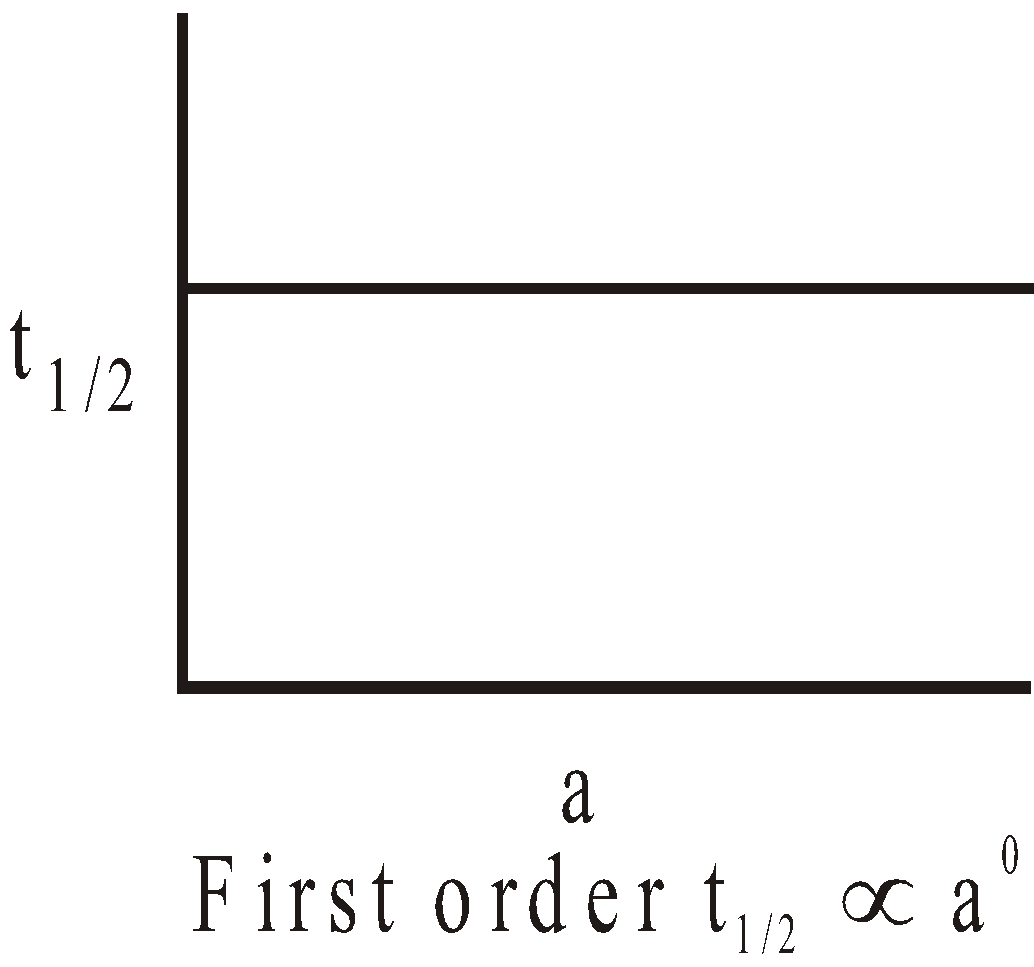
The half-life period of the first order reaction is independent of the initial concentration of reacting substances.

Note : The time taken for the completion of any fraction of the reaction is independent of the initial concentration.

First order growth kinetics : It is used in population growth and bacteria multiplication
Chemical-Kinetics-online-neet-coaching-delhi-tuition-class-12-science-chemistry
where a is initial population and (a + x) population after time t.

SECOND ORDER REACTION

The reaction rate is determined by the variation of two concentration terms. They are of two types
(a) Chemical-Kinetics-online-neet-coaching-delhi-tuition-class-12-science-chemistry
Chemical-Kinetics-online-neet-coaching-delhi-tuition-class-12-science-chemistry
(b) Chemical-Kinetics-online-neet-coaching-delhi-tuition-class-12-science-chemistry
Chemical-Kinetics-online-neet-coaching-delhi-tuition-class-12-science-chemistry
For the (a) type of reaction
Unit of k = conc–1 time–1 = (mol L–1)–1 time–1 i.e. mol–1 L. s–1
When , Chemical-Kinetics-online-neet-coaching-delhi-tuition-class-12-science-chemistry . Chemical-Kinetics-online-neet-coaching-delhi-tuition-class-12-science-chemistry
Half-life period (t1/2) = Chemical-Kinetics-online-neet-coaching-delhi-tuition-class-12-science-chemistryChemical-Kinetics-online-neet-coaching-delhi-tuition-class-12-science-chemistry
The time taken for the completion of half of the reaction is inversely proportional to the initial concentration of the reactant.
Note:  The time taken for the completion of half or any fraction of the reaction is inversely proportional to the initial concentration of the reactant.

THIRD ORDER REACTION

The reaction rate is determined by the variation of three concentration terms. They are of three types
(a) Chemical-Kinetics-online-neet-coaching-delhi-tuition-class-12-science-chemistry
Chemical-Kinetics-online-neet-coaching-delhi-tuition-class-12-science-chemistry
(b) Chemical-Kinetics-online-neet-coaching-delhi-tuition-class-12-science-chemistry
Chemical-Kinetics-online-neet-coaching-delhi-tuition-class-12-science-chemistry
(c) Chemical-Kinetics-online-neet-coaching-delhi-tuition-class-12-science-chemistry
Chemical-Kinetics-online-neet-coaching-delhi-tuition-class-12-science-chemistry
Consider the type (a) k = Chemical-Kinetics-online-neet-coaching-delhi-tuition-class-12-science-chemistry
Unit of k = (mol L–1)–2 s–1 = mol–2 L2 s–1
When t = t1/2, x = a/2
Half-life period (t1/2) =Chemical-Kinetics-online-neet-coaching-delhi-tuition-class-12-science-chemistry
The time taken for the completion of half of the reaction is inversely proportional to the square of the initial concentration of reactants.

Note : The time taken for the completion of any fraction of the reaction is inversely proportional to the square of the initial concentration of reactants.

ZERO ORDER REACTION

The reaction rate is independent of the concentration of the reactants.
Chemical-Kinetics-online-neet-coaching-delhi-tuition-class-12-science-chemistry
Rate = k[A]0 or Chemical-Kinetics-online-neet-coaching-delhi-tuition-class-12-science-chemistry on integration
x = kt + c
when t = 0, x = 0 so c = 0
Hence x = kt or k =
Unit of k = Conc. time–1 = mol L–1 s–1
When the reaction is complete, C = 0
Chemical-Kinetics-online-neet-coaching-delhi-tuition-class-12-science-chemistry
For zero order reaction
Chemical-Kinetics-online-neet-coaching-delhi-tuition-class-12-science-chemistry
Co = initial conc.
C = conc. at any time t
When Chemical-Kinetics-online-neet-coaching-delhi-tuition-class-12-science-chemistry
Half life period (t1/2) = Chemical-Kinetics-online-neet-coaching-delhi-tuition-class-12-science-chemistryChemical-Kinetics-online-neet-coaching-delhi-tuition-class-12-science-chemistry
Note : The time taken for the completion of half of the reaction is directly proportional to the initial concentration of reactants.

For zero order reaction,
  • Rate is independent of concentration of reactant (s)
  • Concentration of reactants do not vary with time
  • Rate does not vary with time.
  • Rate is always equal to rate constant.
  • Chemical-Kinetics-online-neet-coaching-delhi-tuition-class-12-science-chemistry
  • If we double the amount of reactants then time for completion will be doubled.  

HALF-LIFE PERIOD FOR THE Nth ORDER REACTION

When the order of reaction is n, t1/2 is given by
Chemical-Kinetics-online-neet-coaching-delhi-tuition-class-12-science-chemistry
Unit of k = (conc)1–n. time–1

FRACTIONAL ORDER REACTIONS

  • Reaction between H2 and D2.
Rate  = k PH2 (PD2)1/2. Order w.r.t. D2 is 1/2.
  • Conversion of para hydrogen to ortho hydrogen at high temperature.
Chemical-Kinetics-online-neet-coaching-delhi-tuition-class-12-science-chemistry
Order w.r.t. H2 is 3/2.

NEGATIVE ORDER REACTIONS

Conversion of ozone into oxygen.
Rate = K [O3]2 [O2]–1
Order with respect to oxygen is –1.

DETERMINATION OF ORDER OF REACTION

  • FRACTIONAL CHANGE METHOD
The time required to complete a definite fraction of reaction is given by
Chemical-Kinetics-online-neet-coaching-delhi-tuition-class-12-science-chemistry where n is order of reaction
The following graphs are obtained between t1/2 and initial concentration 'a'.
I.Chemical-Kinetics-online-neet-coaching-delhi-tuition-class-12-science-chemistry
II. Chemical-Kinetics-online-neet-coaching-delhi-tuition-class-12-science-chemistry
III. Chemical-Kinetics-online-neet-coaching-delhi-tuition-class-12-science-chemistry
where n = 2 & 3
Chemical-Kinetics-online-neet-coaching-delhi-tuition-class-12-science-chemistry
  • GRAPHICAL METHOD
  1. The graphs between concentration of any reactant Vs. time or concentration of any product Vs. time are plotted. The slope of the tangent to the curve gives the rate of reaction at that time.
Chemical-Kinetics-online-neet-coaching-delhi-tuition-class-12-science-chemistry
The new graphs between Chemical-Kinetics-online-neet-coaching-delhi-tuition-class-12-science-chemistry Vs. (a – x), (a – x)2  or (a – x)3  are plotted.
Chemical-Kinetics-online-neet-coaching-delhi-tuition-class-12-science-chemistry

(b) Making use of integrated form of rate expression
Chemical-Kinetics-online-neet-coaching-delhi-tuition-class-12-science-chemistry         Chemical-Kinetics-online-neet-coaching-delhi-tuition-class-12-science-chemistry
 Zero order Chemical-Kinetics-online-neet-coaching-delhi-tuition-class-12-science-chemistry
Chemical-Kinetics-online-neet-coaching-delhi-tuition-class-12-science-chemistry
Chemical-Kinetics-online-neet-coaching-delhi-tuition-class-12-science-chemistry          Chemical-Kinetics-online-neet-coaching-delhi-tuition-class-12-science-chemistry
Chemical-Kinetics-online-neet-coaching-delhi-tuition-class-12-science-chemistryChemical-Kinetics-online-neet-coaching-delhi-tuition-class-12-science-chemistry

Evaluation of k
For zero order slope = Chemical-Kinetics-online-neet-coaching-delhi-tuition-class-12-science-chemistry
For I order slope = Chemical-Kinetics-online-neet-coaching-delhi-tuition-class-12-science-chemistry;  k can be calculated
For II order slope =Chemical-Kinetics-online-neet-coaching-delhi-tuition-class-12-science-chemistry ; k can be calculated
For III order slope = Chemical-Kinetics-online-neet-coaching-delhi-tuition-class-12-science-chemistry; k can be calculated

  • Use of differential rate equations.
  • Use of integral rate equations – hit and trial method
  • Ostwald's isolation method.

EXAMPLES OF REACTIONS OF DIFFERENT ORDER

REACTIONS OF ZERO ORDER
  • Chemical-Kinetics-online-neet-coaching-delhi-tuition-class-12-science-chemistry
  • Chemical-Kinetics-online-neet-coaching-delhi-tuition-class-12-science-chemistry
  • Chemical-Kinetics-online-neet-coaching-delhi-tuition-class-12-science-chemistry  

REACTIONS OF IST ORDER
  • Chemical-Kinetics-online-neet-coaching-delhi-tuition-class-12-science-chemistry
  • Chemical-Kinetics-online-neet-coaching-delhi-tuition-class-12-science-chemistry
  • Chemical-Kinetics-online-neet-coaching-delhi-tuition-class-12-science-chemistry
  • Chemical-Kinetics-online-neet-coaching-delhi-tuition-class-12-science-chemistry
  • Chemical-Kinetics-online-neet-coaching-delhi-tuition-class-12-science-chemistry
  • Chemical-Kinetics-online-neet-coaching-delhi-tuition-class-12-science-chemistry
  • Chemical-Kinetics-online-neet-coaching-delhi-tuition-class-12-science-chemistry
  • Chemical-Kinetics-online-neet-coaching-delhi-tuition-class-12-science-chemistry
  • Chemical-Kinetics-online-neet-coaching-delhi-tuition-class-12-science-chemistry

REACTIONS OF II ORDER
  • Chemical-Kinetics-online-neet-coaching-delhi-tuition-class-12-science-chemistry
  • Chemical-Kinetics-online-neet-coaching-delhi-tuition-class-12-science-chemistry
  • Chemical-Kinetics-online-neet-coaching-delhi-tuition-class-12-science-chemistry
  • Chemical-Kinetics-online-neet-coaching-delhi-tuition-class-12-science-chemistry
  • Chemical-Kinetics-online-neet-coaching-delhi-tuition-class-12-science-chemistry
  • Chemical-Kinetics-online-neet-coaching-delhi-tuition-class-12-science-chemistry
  • Chemical-Kinetics-online-neet-coaching-delhi-tuition-class-12-science-chemistry
  • Chemical-Kinetics-online-neet-coaching-delhi-tuition-class-12-science-chemistry
  • Chemical-Kinetics-online-neet-coaching-delhi-tuition-class-12-science-chemistry

REACTIONS OF III ORDER
  • Chemical-Kinetics-online-neet-coaching-delhi-tuition-class-12-science-chemistry
  • Chemical-Kinetics-online-neet-coaching-delhi-tuition-class-12-science-chemistry
  • Chemical-Kinetics-online-neet-coaching-delhi-tuition-class-12-science-chemistry
  • Chemical-Kinetics-online-neet-coaching-delhi-tuition-class-12-science-chemistry
  • Chemical-Kinetics-online-neet-coaching-delhi-tuition-class-12-science-chemistry
  • Chemical-Kinetics-online-neet-coaching-delhi-tuition-class-12-science-chemistry
  • Chemical-Kinetics-online-neet-coaching-delhi-tuition-class-12-science-chemistry

REACTIONS OF FRACTIONAL ORDER
  • Chemical-Kinetics-online-neet-coaching-delhi-tuition-class-12-science-chemistryChemical-Kinetics-online-neet-coaching-delhi-tuition-class-12-science-chemistry
  • Chemical-Kinetics-online-neet-coaching-delhi-tuition-class-12-science-chemistryChemical-Kinetics-online-neet-coaching-delhi-tuition-class-12-science-chemistry
  • Chemical-Kinetics-online-neet-coaching-delhi-tuition-class-12-science-chemistryChemical-Kinetics-online-neet-coaching-delhi-tuition-class-12-science-chemistry

REACTION OF IV ORDER
Chemical-Kinetics-online-neet-coaching-delhi-tuition-class-12-science-chemistry

COLLISION THEORY

Chemical reaction occurs as a result of effective collisions between reacting molecules. For this two things are important.
  • Proper orientation of reacting molecules.
  • Possession of certain minimum amount of energy by reacting molecules

THRESHOLD ENERGY

The minimum amount of energy possessed by the reacting molecules to have effective collisions, resulting in the formation of product, is called threshold energy.

ACTIVATION ENERGY (Ea)

The excess energy over and above  the average potential energy possessed by reacting molecules to have effective collisions resulting in the formation of product is known as activation energy.
Activation Energy = threshold energy – average energy of reactants
For fast reaction the activation energy is low.
For slow reaction the activation energy is high.

COLLISION FREQUENCY (Z)

Total number of collisions which occur among the reacting molecules per second per unit volume is called collision frequency. Its value is given by
z  = Chemical-Kinetics-online-neet-coaching-delhi-tuition-class-12-science-chemistry
Chemical-Kinetics-online-neet-coaching-delhi-tuition-class-12-science-chemistry = average velocity, s = molecular diameter in cm.,
n = number of molecules per cc.

RATE OF REACTION FROM COLLISION THEORY

It is given by
Rate of reaction  = f × z
z = collision frequency, f = fraction of effective collisions
  = Chemical-Kinetics-online-neet-coaching-delhi-tuition-class-12-science-chemistry
Rate (k) = Chemical-Kinetics-online-neet-coaching-delhi-tuition-class-12-science-chemistry

GRAPHICAL REPRESENTATION OF EXOTHERMIC REACTION

Chemical-Kinetics-online-neet-coaching-delhi-tuition-class-12-science-chemistry
where F.R. = Forward reaction and B.R. = Backward reaction
Chemical-Kinetics-online-neet-coaching-delhi-tuition-class-12-science-chemistry
Graphical representation of endothermic reaction :
Chemical-Kinetics-online-neet-coaching-delhi-tuition-class-12-science-chemistry

GRAPHICAL REPRESENTATION OF THE EFFECT OF TEMPERATURE ON RATE OF REACTION

Fraction of the molecules having energy equal to activation energy is shown by shaded portion. The fraction of such molecules become almost double for 10°C rise of temperature and the rate of reaction almost doubles for 10°C rise of temperature.
Chemical-Kinetics-online-neet-coaching-delhi-tuition-class-12-science-chemistry

PHOTOCHEMICAL REACTIONS

Reactions which take place by the absorption of radiations of suitable wavelength e.g.
Chemical-Kinetics-online-neet-coaching-delhi-tuition-class-12-science-chemistry
Photosynthesis of carbohydrates in plants takes place in presence of chlorophyll and sunlight.
Chemical-Kinetics-online-neet-coaching-delhi-tuition-class-12-science-chemistry

FREE ENERGY CHANGE IN PHOTOCHEMICAL REACTIONS

The free energy change of a photochemical reaction may not be negative. In the synthesis of carbohydrates and formation of HCl, Chemical-Kinetics-online-neet-coaching-delhi-tuition-class-12-science-chemistryG is +ve.

PHOTOSENSITISATION

Certain molecules absorb light energy and transfer it to another molecule which may undergo a reaction. The process is called photosensitisation and the substance doing so is called photosensitizer e.g. chlorophyll acts as photosensitizer in photosynthesis.

VISION

The isomerisation of retina by absorbing photon of light in the retina of eye and reconversion to original form by releasing energy is known as vision.

GROTTHUS-DRAPER LAW

Only those rays which are absorbed by the substance are effective in producing a chemical change. A part of light is reflected and transmitted also.

LAW OF PHOTOCHEMICAL EQUIVALENCE OR EINSTEIN'S LAW (STARK-EINSTEIN LAW)

In a photochemical reaction, one quantum of active light (photon) is absorbed per molecule of the reacting substance which disappears.

QUANTUM EFFICIENCY OR QUANTUM YIELD

Number of moles reacting per Einstein of the light absorbed. It is expressed as

Chemical-Kinetics-online-neet-coaching-delhi-tuition-class-12-science-chemistry

CHEMILUMINESCENCE

Emission of light in a chemical reaction at ordinary temperature is called chemiluminescence.

FLUORESCENCE

The absorption of energy and instantaneous re-emitting of the energy is called fluorescence.

PHOSPHORESCENCE

The continuous glow of some substances even after the cutting of source of light is called phosphorescence e.g. ZnS.

BIOLUMINESCENCE

The phenomenon of chemiluminescence exhibited by certain living organisms is called bioluminescence e.g. light emission by fireflies.

EFFECT OF CATALYST ON REACTION RATES

A catalysed reaction provides a new pathway or a mechanism by which the potential energy barrier between the reactants and products is lowered. The graphical representation is as follows :
                  Chemical-Kinetics-online-neet-coaching-delhi-tuition-class-12-science-chemistry
  • ΔH (enthalpy) of reaction remains the same for catalysed as well as uncatalysed reaction.
  • Energy of activation is lowered considerably for catalysed forward and backward reactions.

STUDY OF KINETICS OF SOME REACTIONS

HYDROLYSIS OF AN ESTER

CH3COOC2H5 + H2O Chemical-Kinetics-online-neet-coaching-delhi-tuition-class-12-science-chemistry  CH3COOH + C2H5OH
It is biomolecular and 1 order. The rate constant is given by
Chemical-Kinetics-online-neet-coaching-delhi-tuition-class-12-science-chemistry
Initial conc. of ester Chemical-Kinetics-online-neet-coaching-delhi-tuition-class-12-science-chemistry and conc. of ester present after timeChemical-Kinetics-online-neet-coaching-delhi-tuition-class-12-science-chemistry .

INVERSION OF CANE SUGAR

Chemical-Kinetics-online-neet-coaching-delhi-tuition-class-12-science-chemistry
The change is noted by rotation of plane polarised light in a polarimeter.
Chemical-Kinetics-online-neet-coaching-delhi-tuition-class-12-science-chemistry
Hence velocity constant k is given by
Chemical-Kinetics-online-neet-coaching-delhi-tuition-class-12-science-chemistry

SAPONIFICATION OF ETHYL ACETATE

Chemical-Kinetics-online-neet-coaching-delhi-tuition-class-12-science-chemistry
Bimolecular II order reaction.

The value of k =Chemical-Kinetics-online-neet-coaching-delhi-tuition-class-12-science-chemistry

Notes For Class 12 Chemistry Janakpuri, Delhi-Biology Class 12 Notes, Chemistry Class 12 Notes, Chemistry Notes for Class 12, Chemistry Notes for Class 12, Notes For Chemistry Class 12, Chemistry lectures Class 12, Chemistry classroom lectures Class 12, best Chemistry Notes for Class 12, best Chemistry lectures for Class 12, grade 11 Chemistry Notess, Class 12 Chemistry chapter 1 Notes, Class 12 Chemistry chapter 2 Notes, Class 12 Chemistry chapter 3 Notes, Chemistry Class 12 Notes free download, Chemistry Class 12 animation Notes, animation Notes for Class 12, neet, science, coaching classes, tutors, competitive exam preparation, study center, learning center, best coaching, top coaching, online coaching, offline coaching, Study Material, Books, DVDs, Notes

Want to know more

Please fill in the details below:

Name

Admissions,1,Alternating Current,60,AP EAMCET 2020,1,Basic Maths,2,BCECE 2020,1,best books for iit jee,2,best coaching institute for iit,1,best coaching institute for iit jee preparation,1,best iit jee coaching delhi,1,best iit jee coaching in delhi,2,best study material for iit jee,4,BITSAT Registration 2020,1,Blog,62,books for jee preparation,1,books recommended by iit toppers,3,Capacitance,3,CBSE,1,CBSE accounts exam,1,CBSE boards,1,CBSE NEET,9,cbse neet 2019,3,CBSE NEET 2020,1,cbse neet nic,1,Centre of Mass,2,Chemistry,58,Class 12 Chemistry,15,coaching for jee advanced,1,coaching institute for iit jee,2,Collision,2,COMEDK UGET 2020 Application Form,1,COMEDK UGET 2020 Exam Form,1,COMEDK UGET news,1,CUCET 2020,2,Current Electricity,4,CVR college,1,Digestion and Absorption Notes PDF,1,Electromagnetic Induction,3,Electronics,1,Electrostatics,3,Energy,1,Engineering & Medical,1,Fluid Mechanics,4,Gravitation,2,GUJCET 2020 Application Form,1,Heat,4,iit admission,1,iit advanced,1,iit coaching centre,3,iit coaching centre in delhi,2,iit coaching classes,2,iit coaching in delhi,1,iit coaching institute in delhi,1,iit entrance exam,1,iit entrance exam syllabus,2,iit exam pattern,2,iit jee,5,iit jee 2019,3,iit jee advanced,2,iit jee books,3,iit jee coaching,2,iit jee exam,3,iit jee exam 2019,1,iit jee exam pattern,3,iit jee institute,1,iit jee main 2019,2,iit jee mains,3,iit jee mains syllabus,2,iit jee material,1,iit jee online test,3,iit jee practice test,3,iit jee preparation,6,iit jee preparation in delhi,2,iit jee preparation time,1,iit jee preparation tips by toppers,2,iit jee question paper,1,iit jee study material,3,iit jee study materials,2,iit jee syllabus,2,iit jee syllabus 2019,2,iit jee test,3,iit preparation,2,iit preparation books,5,iit preparation time table,2,iit preparation tips,2,iit syllabus,2,iit test series,3,IITJEE,100,Important Chemistry Notes for NEET Preparation,1,IPU CET,1,JEE Advanced,83,jee advanced exam,2,jee advanced exam pattern,1,jee advanced paper,1,JEE Books,1,JEE Coaching Delhi,3,jee exam,3,jee exam 2019,6,JEE Exam Pattern,2,jee exam pattern 2019,1,jee exam preparation,1,JEE Main,85,jee main 2019,4,JEE Main 2020,1,JEE Main 2020 Application Form,2,JEE Main 2020 news,2,JEE Main 2020 Official Answer Key,1,JEE Main 2020 Registration,1,JEE Main 2020 Score,1,JEE Main application form,1,jee main coaching,1,JEE Main eligibility criteria,3,jee main exam,1,jee main exam 2019,3,jee main online question paper,1,jee main online test,3,JEE Main Paper-2 Result,1,jee main registration,2,jee main syllabus,2,JEE mains 2020,1,jee mains question bank,1,jee mains test papers,3,JEE Mock Test,2,jee notes,1,jee past papers,1,JEE Preparation,2,jee preparation in delhi,1,jee preparation material,4,JEE Study Material,1,jee syllabus,6,JEE Syllabus Chemistry,1,JEE Syllabus Maths,1,JEE Syllabus Chemistry,1,jee test series,3,KCET - 2020,1,Kinematics,1,Latest article,5,Latest Articles,61,Latest News,34,latest news about neet exam,1,Laws of Motion,2,Magnetic Effect of Current,3,Magnetism,3,MHT CET 2020,2,MHT CET 2020 exam schedule,1,Modern Chemistry,1,NCERT Chemical Kinetics,15,neet,3,neet 2019,1,neet 2019 eligibility criteria,1,neet 2019 exam date,2,neet 2019 test series,2,NEET 2020,2,NEET 2020 Application Form,1,NEET 2020 Eligibility Criteria,1,NEET 2020 Registration,1,neet application form,1,neet application form 2019 last date,1,Neet Chemistry Syllabus,1,Neet Books,3,neet eligibility criteria,3,neet exam 2019,7,neet exam application,1,neet exam date,1,neet exam details,1,neet exam pattern,6,neet exam pattern 2019,2,neet examination,1,neet mock test 2019,1,Neet Notes,3,Neet Online Application Form,3,neet online test,2,neet past papers,1,neet Chemistry syllabus,1,neet practice test,2,NEET preparation books,1,neet qualification marks,1,NEET question paper 2019,1,neet question papers,1,neet registration,1,Neet Study Material,3,neet syllabus,6,neet syllabus 2019,5,NEET Syllabus 2020,1,neet syllabus Chemistry,1,neet syllabus for Chemistry,1,neet syllabus for Chemistry,1,neet test series,1,neet ug 2019,2,news,5,online study material for iit jee,1,Optical Instruments,1,Chemistry,110,Chemistry books for iit jee,1,Power,1,Practical Chemistry,1,Quiz,5,Ray Optics,1,Rotational Motion,3,SHM,3,Simple Harmonic Motion,3,study materials for iit jee,1,Study Notes,110,study notes for iit jee,1,Thermodynamics,4,TS EAMCET Notification,2,Units and Dimensions,1,UPSEE 2020,1,UPSEE 2020 Application Form,2,UPSEE EXAM,1,Vectors,2,VITEE Application form,1,Wave Motion,3,Wave Optics,1,WBJEE 2020 Admit Card,1,WBJEE 2020 Answer Key,1,Work,1,
ltr
item
BEST NEET COACHING CENTER | BEST IIT JEE COACHING INSTITUTE | BEST NEET & IIT JEE COACHING: Chemical Kinetics | Chemistry Notes for IITJEE/NEET
Chemical Kinetics | Chemistry Notes for IITJEE/NEET
https://drive.google.com/thumbnail?id=1RBShNwZNA7H5_QhTsiZyutKRTJ916Khy&sz=s800
https://drive.google.com/thumbnail?id=1RBShNwZNA7H5_QhTsiZyutKRTJ916Khy&sz=s800=s72-c
BEST NEET COACHING CENTER | BEST IIT JEE COACHING INSTITUTE | BEST NEET & IIT JEE COACHING
https://www.Neetbharath.in/2019/05/Chemistry-notes-physical-world.html
https://www.Neetbharath.in/
https://www.Neetbharath.in/2019/05/Chemistry-notes-physical-world.html
true
7783647550433378923
UTF-8
Chemical Kinetics: Online Neet Class-11 Chemistry Notes Janakpuri | Best Digital Neet Coaching Janakpuri, West Delhi | Online Neet Coaching Centers in Janakpuri, Delhi | Online Neet exams tuitions in Janakpuri | Experienced teachers of Chemistry to help Online Neet aspirants | Online Neet exams | Online Neet exam date | Online Neet exam Chemistry syllabus | Online Neet exam Chemistry syllabus | Online Neet exam Chemistry syllabus | Online Neet exam syllabus, date, criteria and pattern | best books for Online Neet exam Janakpuri, West Delhi | best online coaching for Online Neet exam Janakpuri, West Delhi | best study material for Online Neet exam Janakpuri, West Delhi | Online Neet exam centre in Janakpuri, West Delhi | Online Neet audio video lectures Janakpuri, West Delhi | Online Neet videos Janakpuri, West Delhi | Online Neet classroom videos Mayapuri, West Delhi | Online Neet question papers Mangolpuri, West Delhi | Online Neet test series papers with Chemical Kinetics Saraswati Vihar, West Delhi | Online Neet previous years question sample papers Peeragarhi, West Delhi | how to crack Online Neet exams Palam Colony, West Delhi | Online Neet exam duration Paschim Vihar, West Delhi | Online Neet exam eligibility criteria Budh Vihar, West Delhi | Online CBSE School Class 12 Science subject study material Janakpuri, West Delhi | Online CBSE School Class 12 Science subject study material Janakpuri A/B/C/D Block, West Delhi | Online CBSE School Class 12 Chemistry subject study material Janakpuri East-West Metro Station, West Delhi | Online CBSE School Class 12 Chemistry subject study material Janakpuri, West Delhi | Online CBSE School Class 12 Chemistry subject study material Dabri Mor, West Delhi | Online CBSE School Class 12 Chemistry subject study material Tilak Nagar, West Delhi | Online CBSE School Class 12 Chemistry subject study material Sagar Pur, West Delhi | Online CBSE School Class 12 Chemistry subject study material Uttam Nagar, West Delhi | Online CBSE School Class 12 Chemistry video lectures Vikaspuri, West Delhi | Online CBSE School Class 12 Chemistry video lectures Hari Nagar, West Delhi | Online CBSE School Class 12 Chemistry video lectures Dwarka sector 4/6/7/12/22/10/23/dwarka mor, West Delhi | Online CBSE School Class 12 Chemistry video lectures Subhash Nagar, West Delhi | Online CBSE School Class 12 Chemistry video lectures Kirti Nagar, West Delhi | Online CBSE School Class 12 Chemistry video lectures Rajouri Garden, West Delhi | Online CBSE School Class 12 Chemistry sample question papers Moti Nagar, West Delhi | Online CBSE School Class 12 Chemistry sample question papers Najafgarh, West Delhi | Online CBSE School Class 12 Chemistry sample question papers Virender Nagar, West Delhi | Online CBSE School Class 12 Chemistry sample question papers Punjabi Bagh, West Delhi | Online CBSE School Class 12 Chemistry sample question papers Rohini sec 9/3/24/11/7/8/16, West Delhi | Online CBSE School Class 12 Chemistry sample question papers Pitampura, West Delhi | Janakpuri A/B/C/D Block | Janakpuri East-West Metro Station | Dabri Mor | Tilak Nagar | Sagar Pur | Uttam Nagar | Vikaspuri | Hari Nagar | Dwarka sector 4/6/7/12/22/10/23/dwarka mor | Subhash Nagar | Kirti Nagar | Rajouri Garden | Moti Nagar | Najafgarh | Virender Nagar | Punjabi Bagh | Rohini sec 9/3/24/11/7/8/16 | Pitampura | Budh Vihar | Paschim Vihar | Palam Colony | Peeragarhi | Saraswati Vihar | Mangolpuri | Mayapuri.

NEET Previous Year Sample Papers


error: Content is protected !!