


 9868233590

Subject: Class 12 Biology Online Coaching For Neet Exam
Phone: +91-9868233590
Class 12 Biology Online Coaching For Neet Exam
Reproductive health Class 12 Biology Notes
REPRODUCTIVE HEALTH
INTRODUCTION
According to the World Health Organisation (WHO), reproductive health means a total well-being in all aspects of reproduction, i.e., physical, emotional, behavioural and social.
REPRODUCTIVE HEALTH PROBLEMS AND STRATEGIES
- India was amongst the first countries in the world to initiate the programmes called ‘family planning’ in 1951 which were periodically assessed over the past decades.
- Reproductive health in a society forms a crucial part of general health. Some crucial concerns are as follows-
- complication of pregnancy, childbirth and unsafe abortion.
- maximum infection rates of sexually transmitted diseases (including HIV/AIDS) among the young people (15 to 24 years).
- less education and lower future income for young mothers due to early pregnancy and child bearing.
- Improved programmes covering wider reproduction-related areas are currently in operation under the popular name ‘Reproductive and Child Health Care (RCH) programmes’.
- Health and education of young people and marriage and childbearing during more mature stages of life are important attributes to the reproductive health of a society.
- Reproductive health programmes :
- create awareness in both males and females about various reproduction related aspects with the help of audio-visual and print media.
- provide sex education in schools to save the young school goers from myths and misconceptions about the sex related issues.
- provide proper information about reproductive organs, adolescence and safe hygienic sexual practices.
- educate the fertile couples and those in marriageable age group about birth control measures, prenatal and post natal care of mothers and child etc.
POPULATION EXPLOSION AND BIRTH CONTROL
- The rapid increase in human population size over a relatively short period is called human population explosion.
- Population growth rate depends on factors like fertility, natality, mortality, migration, age and sex structure.
- The regulation of conception by preventive methods or devices to limit the number of offsprings is called birth control.
- A birth control method which deliberately prevents fertilization is referred to as contraception.
- Contraceptive methods are preventive methods and are of
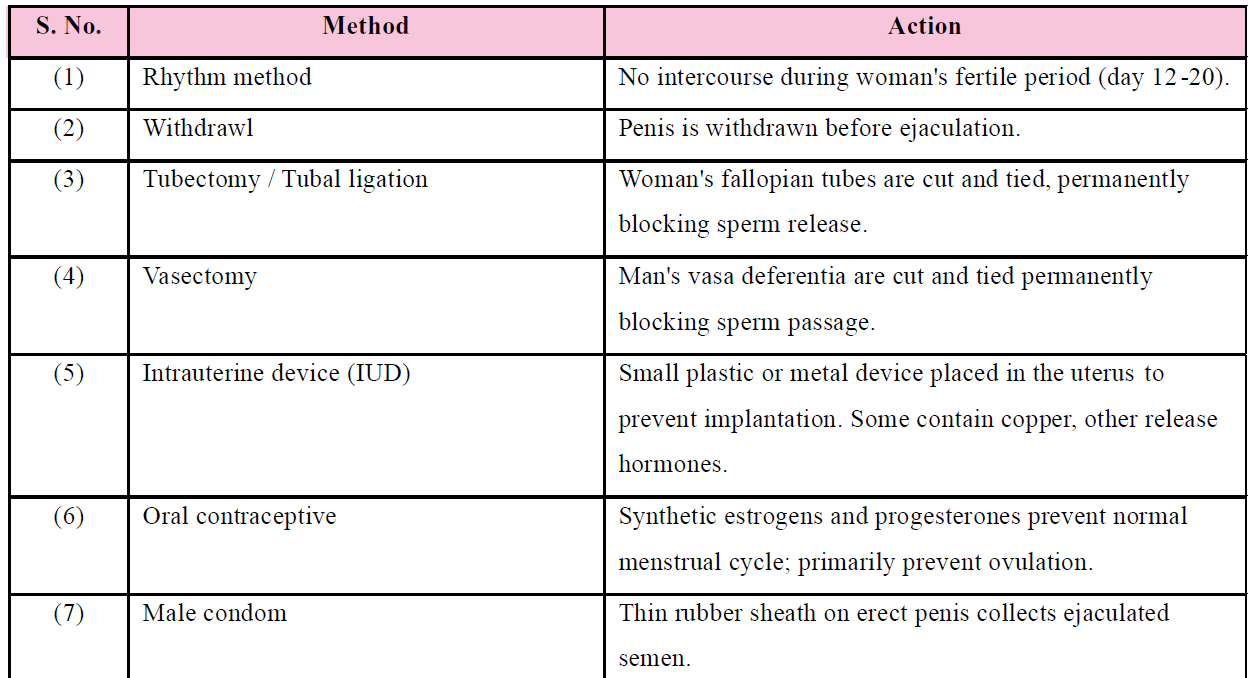
2 types - temporary and permanent. - Temporary methods includes natural method, chemical method, mechanical means, physiological devices or hormonal methods and permanent method includes sterilization.
- Natural methods work on the principle of avoiding chances of ovum and sperm meeting. It includes safe period, abstinence, coitus interruptus and lactational amenorrhea.
- A week before and a week after menses is considered as safe period (rhythm method) for sexual intercourse. The idea is based on the following facts-
- Ovulation occurs on the 14th day of menstruation.
- Ovum survives for about 2 days.
- Sperms remain alive for about 3 days.
- Periodic abstinence is one such method in which the couples avoid or abstain from coitus from day 10 to 17 of the menstrual cycle when ovulation could be expected. As chances of fertilization are very high during this period, it is called the fertile period. Therefore, by abstaining from coitus during this period, conception could be prevented.
- Withdrawal or coitus interruptus (oldest method) is another method in which the male partner withdraws his penis from the vagina just before ejaculation so as to avoid insemination. This method has some drawbacks like male produces some lubricating fluid containing some sperm from his cowper's gland before ejaculation.
- Lactational amenorrhea (absence of menstruation) method is based on the fact that ovulation and therefore the cycle do not occur during the period of intense lactation following parturition. Therefore, as long as the mother breast feeds the child fully, chances of conception are almost nil.
- Chemical methods means spermicides (such as lactic acid, citric acid, boric acid, potassium permanganate and zinc sulphate). Foams, jellies, pastes and creams, if introduced before sexual intercourse into the vagina, adhere to the mucous membrane and immobilize and kill the sperm by inhibiting oxygen intake.
- In mechanical methods, ovum and sperm are prevented from physically meeting with the help of barriers. Such methods are available for both males and females.
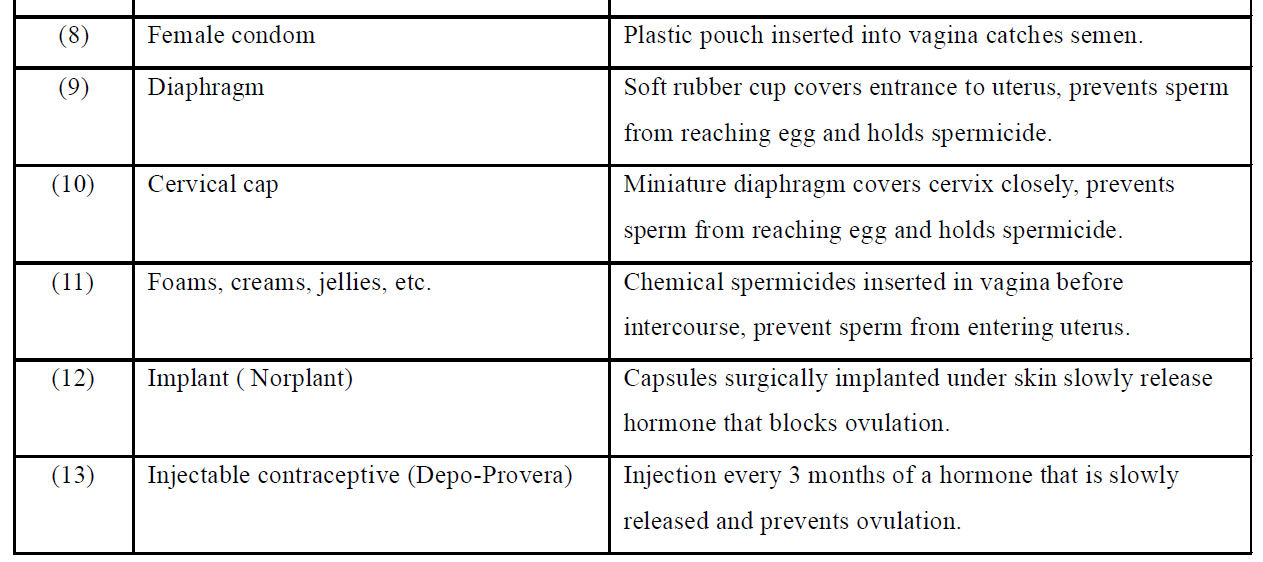
- Mechanical methods are of following types condom, diaphragm, cervical caps, vaults and intrauterine devices (IUDs).
- Condoms are barriers made of thin rubber/latex sheath that are used to cover the penis in the male just before coitus so that the ejaculated semen would not enter into the female reproductive tract. This can prevent conception.
- Diaphragms, cervical caps and vaults are rubber that are inserted into the female reproductive tract to cover the cervix during coitus. These prevent conception by blocking the entry of sperm through the cervix. These are reusable. Spermicidal creams, jellies and foams are usually used along with these barriers to increase their contraceptive efficiency.
- IntraUterine Devices (IUDs) are inserted by doctors in the uterus through vagina. These Intra Uterine Devices are presently available as the non-medicated IUDs (e.g., Lippes loop), copper releasing IUDs (CuT, Cu7, Multiload 375) and the hormone releasing IUDs (Progestasert, LNG-20).
- IUDs increase phagocytosis of sperm within the uterus and the Cu ions released suppress sperm motility and fertilizing capacity of sperm. The hormone releasing IUDs, in addition, making the uterus unsuitable for implantation and the cervix hostile to the sperm.
- IUDs are ideal contraceptives for the females who want to delay pregnancy and/or space children. It is one of the most widely accepted methods of contraception in India.
- Physiological (oral) devices (hormonal) includes birth control pills. Oral administration of small doses of either progestogens or progestogen–estrogen combination is another contraceptive method used by the females. These are used in the form of tablets and hence are popularly called the pills.
- Birth control pills check ovulation by inhibiting the secretion of FSH and LH that are necessary for ovulation.
- Saheli –the new oral contraceptive for the females contains a non-steroidal preparation. It was developed by scientists at Central Drug Research Institute (CDRI) in Lucknow, India.
- Pill Mala D is taken daily, and the pill Saheli is taken weekly.
- Progestogens alone or in combination with estrogen can also be used by females as injections or implants under the skin.
- Surgical methods, also called sterilization, are generally advised for the male/female partner as a terminal method to prevent any more pregnancies. Surgical intervention blocks gamete transport and thereby prevent conception. Sterilization procedures in the male is called ‘vasectomy’ and that in the female, ‘tubectomy’.
- In vasectomy, a small part of the vas deferens is removed or tied up through a small incision on the scrotum whereas in tubectomy, a small part of the fallopian tube is removed or tied up through a small incision in the abdomen or through vagina.
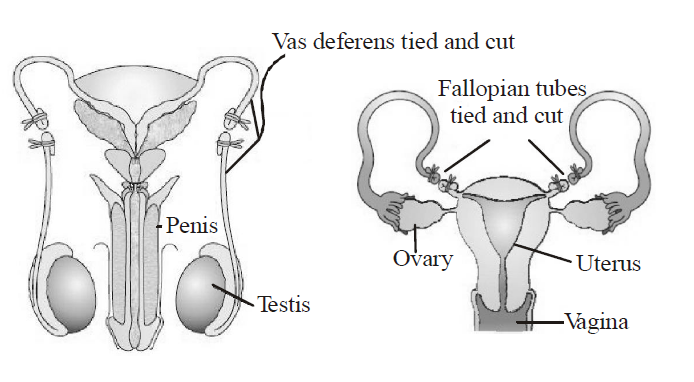
Fig. : Vasectomy and Tubectomy
Table : Method of Birth Control
AMNIOCENTESIS
- Amniocentesis is a pre-natal diagnostic technique to determine.
- Sex of the developing baby.
- Genetically controlled congenital diseases.
- Metabolic disorders in foetus.
- Process of amniocentesis involves the following steps :
- Location of the foetus is determined by a technique called sonography (using high frequency ultrasound waves) to prevent accidental damage to the foetus.
- A fine hollow needle is passed through the abdominal and uterine wall of a pregnant female (about 14th to 15th week after conception) into the amniotic cavity.
- A small amount of amniotic fluid is withdrawn. It contains foetal skin cells and a number of proteins, especially enzymes. The cells can be cultured in vitro for further examination.
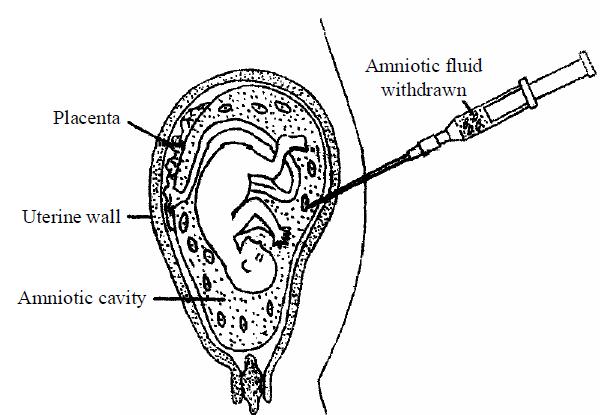
Fig. : Amniocentesis
SIGNIFICANCE OF AMNIOCENTESIS
SEX DETERMINATION
- The somatic cells of foetal skin drawn with the amniotic fluid are stained to determine the presence of sex chromatin (barr body).
- Presence of barr body indicates that the developing foetus as female is with 2 X-chromosomes out of which one X-chromosome is active, while other X-chromosome is heterochromatized into a darkly stained barr body.
CONGENTIAL DISEASE
- By karyotypic studies of somatic cells, abnormalities due to changes in chromosome number like Down's syndrome, Turner's syndrome, Klinefelter's syndrome etc. can be determined.
METABOLIC DISORDER
- By the enzyme analysis of amniotic fluid, different types of inborn metabolic disorders like phenylketonuria, alkaptonuria etc. can be detected.
- These inborn errors are caused by the absence or inactivity of specific enzymes due to gene mutations. So with the help of amniocentesis, if it is confirmed that the child is likely to suffer from some incurable, congenital defect, the mother can go for abortion.
DRAWBACKS OF AMNIOCENTESIS
- However, these days, the amniocentesis is being misused also. Mothers even get their normal foetus aborted if it is a female. This is just equivalent to killing of a normal child. So Govt. of India enforced the Pre-natal Diagnostic Techniques (Regulation and Prevention of Misuse) Act, 1994, since January 1, 1994 under which all genetic counselling centres and laboratories are required to apply for registration.
- The violation of this act can bring a fine of ` 50,000 and imprisonment for two years.
- The doctor's registration is also cancelled till the complaint is disposed of.
CHORIONIC VILLUS SAMPLING (CVS)
- Amniocentesis is possible without a chance of injuring the foetus with the needle only after the sixteenth week of pregnancy. At this time, abortion is not safe. A new technique, named Chorionic Villus Sampling (CVS), can be done during the eighth to tenth week of pregnancy when abortion is safe for the woman. For CVS, cells are sucked into a catheter passed through the cervix. CVS technique provides a mass of rapidly dividing foetal cells, thus facilitating the examination of chromosomal disorders.
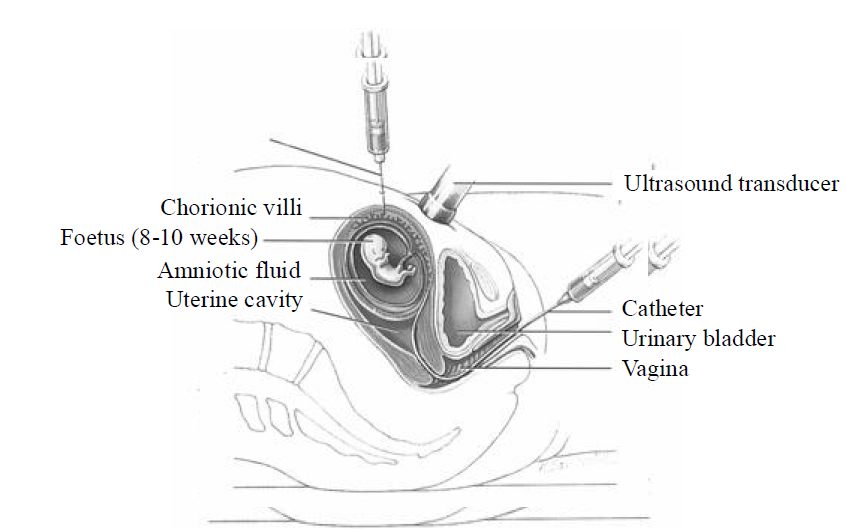
Fig:Chorionic Villus Sampling(CVS)
MEDICAL TERMINATION OF PREGNANCY (MTP)
- Intentional or voluntary termination of pregnancy before full term is called medical termination of pregnancy (MTP) or induced abortion.
- Nearly 45 to 50 million MTPs are performed in a year all over the world which accounts to 1/5th of the total number of conceived pregnancies in a year.
- Government of India legalised MTP in 1971 with some strict conditions to avoid its misuse.
- MTPs are considered relatively safe during the first trimester, i.e., upto 12 weeks of pregnancy.
- Misoprostol (a prostaglandin) along with mifepristone (anti progesterone) is an effective combination. Vacuum aspiration and surgical procedure are adapted thereafter.
- MTP is used to get rid of unwanted pregnancies and where continuation of the pregnancy could be harmful or even fatal either to mother or to the foetus or both.
SEXUALLY TRANSMITTED DISEASES (STDs)
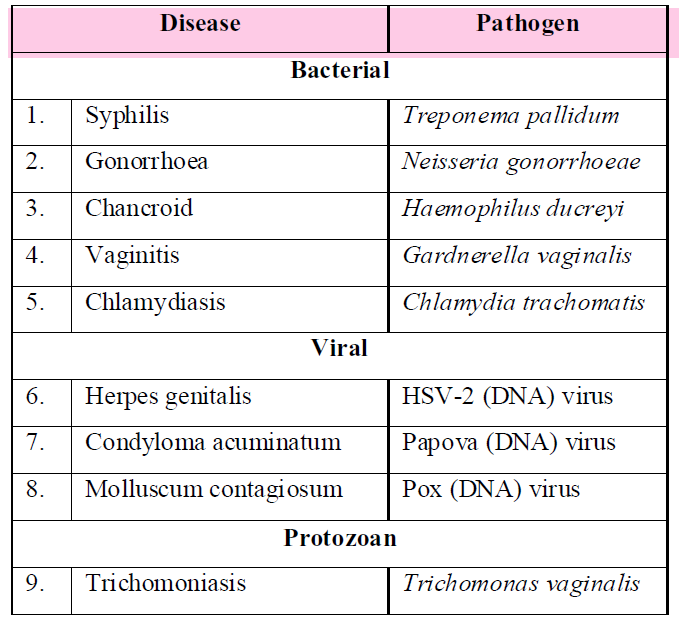
- Diseases which are transmitted through sexual intercourse are collectively called sexually transmitted diseases (STD) or venereal diseases (VD) or reproductive tract infections (RTI).
- These disease are caused by a widerange of bacterial, viral, protozoan, fungal agents and ectoparasites.
Table : Some STDs and their pathogens
- These disease lead to complication later like pelvic inflammatory disease (PID), abortions, still births, ectopic pregnancies, infertility and even cancer of reproductive tract.
- Some of these infections like hepatitis–B and HIV can also be transmitted by sharing of injection needles, surgical instruments, etc., with infected persons, transfusion of blood, or from an infected mother to the foetus too.
- Except for hepatitis-B, genital herpes and HIV infections, other diseases are completely curable if detected early and treated properly.
- Transmission of sexually transmitted disease can be avoided by-
- Avoiding sex with multiple partners or unknown partner.
- Using condoms during coitus.
- Consulting qualified doctors for early detection and get complete treatment if diagnosed with disease.
INFERTILITY
- Inability to conceive or produce children even after 2 years of unprotected sexual cohabitation is called infertility.
- Various methods are now available to help such couples.
- Assisted reproductive technology (ART) includes all fertility treatment in which both sperms and eggs are handled. Art procedure involves surgically removing eggs from a mothers ovaries, combining them with sperm in the laboratory and returning them to the woman's body or donating them to another woman.
- The main ART-techniques include:
- In vitro fertilization (IVF)
- Zygote intra fallopian transfer (ZIFT)
- Intra cytoplasmic sperm injection (ICST).
- Gamete intra fallopian transfer (GIFT).
- Surrogacy or surrogate motherhood.
- In vitro fertilization followed by transfer of embryo into the female genital tract is one such method and is commonly known as the ‘Test Tube Baby’ Programme.
- First attempt to produce a test tube baby was made by a Italian scientist, Dr. Petrucci (1959 A.D.). Although this human embryo survived for only 29 days, but his experiment opened a new file of biological science. The first test tube baby was born to Lesley and Gilbert Brown on July 25, 1978, in Oldham, England. Mrs. Brown had obstructed fallopian tubes. Dr.Patiricke Steptoe and Dr. Robert Edward both from England experimented on Mrs. Brown successfully.
The world's first test tube baby (a baby girl) was named as Louise Joy Brown. Later, test-tube babies were also born in Australia, United States and some other countries. India's first test tube baby was born Durga on 3rd October, 1978 in Kolkata. Her parental name was Kanupriya Aggarwal and was created by Dr. Subash Mukherjee.
- In test-tube baby programme, ova from the wife/donor (female) and sperms from the husband/donor (male) are collected and are induced to form zygote under simulated conditions in the laboratory. The zygote or early embryos (with upto 8 blastomeres) could then be transferred into the fallopian tube (ZIFT–Zygote Intra Fallopian Transfer) and embryos with more than 8 blastomeres, into the uterus (IUT – Intra Uterine Transfer), to complete its further development. Embryos formed by in-vivo fertilization (fusion of gametes within the female) also could be used for such transfer to assist those females who cannot conceive.
- Intra cytoplasmic sperm injection (ICSI) is another specialised procedure to form an embryo in the laboratory in which a sperm is directly injected into the ovum.
- Infertility cases either due to inability of the male partner to inseminate the female or due to very low sperm counts in the ejaculates, could be corrected by artificial insemination (AI) technique. In this technique, the semen collected either from the husband or a healthy donor is artificially introduced either into the vagina or into the uterus (IUI – intra-uterine insemination) of the female.
- Gametic Intra-Fallopian Transfer (GIFT) is the latest technique to produce the child. Sperm (obtained by masturbation/electro ejaculation) and ovum obtained by laproscopy are injected into the mid part of the oviduct by a separate catheter in a cycling female (in proliferative stage).
- Surrogate motherhood is a by product of the artificial insemination. It means that a woman allows a fertilized ovum of another couple to be infected into her womb. Then she carries to its full term for other couple.

