

Notes For Class 11 Chemistry Janakpuri, Delhi-Biology Class 11 Notes, Chemistry Class 11 Notes, Chemistry Notes for Class 11, Chemistry Notes for Class 11, Notes For Chemistry Class 11, Chemistry lectures Class 11, Chemistry classroom lectures Class 11, best Chemistry Notes for Class 11, best Chemistry lectures for Class 11, grade 11 Chemistry Notess, Class 11 Chemistry chapter 1 Notes, Class 11 Chemistry chapter 2 Notes, Class 11 Chemistry chapter 3 Notes, Chemistry Class 11 Notes free download, Chemistry Class 11 animation Notes, animation Notes for Class 11, neet, science, coaching classes, tutors, competitive exam preparation, study center, learning center, best coaching, top coaching, online coaching, offline coaching, Study Material, Books, DVDs, NotesNotes For Class 11 Chemistry Janakpuri, Delhi-Biology Class 11 Notes, Chemistry Class 11 Notes, Chemistry Notes for Class 11, Chemistry Notes for Class 11, Notes For Chemistry Class 11, Chemistry lectures Class 11, Chemistry classroom lectures Class 11, best Chemistry Notes for Class 11, best Chemistry lectures for Class 11, grade 11 Chemistry Notess, Class 11 Chemistry chapter 1 Notes, Class 11 Chemistry chapter 2 Notes, Class 11 Chemistry chapter 3 Notes, Chemistry Class 11 Notes free download, Chemistry Class 11 animation Notes, animation Notes for Class 11, neet, science, coaching classes, tutors, competitive exam preparation, study center, learning center, best coaching, top coaching, online coaching, offline coaching, Study Material, Books, DVDs, Notes

"Organic Chemistry: Some Basic Principles And Techniques"
Neet Chemistry Notes For Class 11

Available courses 29

Organic Chemistry: Some Basic Principles And Techniques/class-11/theory/users/user-profile-theory-chapters-notes-study-material-online-test-papers-with-Organic Chemistry: Some Basic Principles And Techniques-for-neet-entrance-exam-and-school-exams-class-11-12-science-students.jpg
Subject: Class 11 Chemistry Online Coaching For Neet Exam
Phone: +91-9868233590

Organic Chemistry: Some Basic Principles And Techniques Class 11 Chemistry Notes


BASIC CONCEPTS OF ORGANIC CHEMISTRY

ELECTRONEGATIVITY

A covalent bond, where the electrons are shared equally is called a nonpolar bond (eg H–H) and an unequal sharing of the pair of bonding electrons results in a polar bond. The unequal sharing of electrons is due to the ability of an atom to attract electrons towards itself which is known as Electronegativity.

Elements with higher electronegativity values have greater attraction for bonding electrons.
organic-chemistry-some-basic-principles-and-technique-neet-coaching-delhi-tuition-class-11-chemistry
Electronegativity increases from left to right and decreases from top to bottom.

INDUCTIVE EFFECT (I)

The displacement of shared pair of electrons towards the more electronegative atom in a molecule is called inductive effect. It is a permanent effect e.g.

organic-chemistry-some-basic-principles-and-technique-neet-coaching-delhi-tuition-class-11-chemistry
It develops polarity in a bond or molecule.
It is transmitted along a chain of atoms but the intensity goes on decreasing with the increase in the size of chain. For example,

organic-chemistry-some-basic-principles-and-technique-neet-coaching-delhi-tuition-class-11-chemistry
Hence transmission can be ignored after the second C-atom. An atom or group which attracts electrons more strongly than hydrogen is said to have a negative inductive effect (–I). An atom or group which attracts electrons less strongly than hydrogen is said to have a positive inductive effect (+I).
organic-chemistry-some-basic-principles-and-technique-neet-coaching-delhi-tuition-class-11-chemistryorganic-chemistry-some-basic-principles-and-technique-neet-coaching-delhi-tuition-class-11-chemistry
organic-chemistry-some-basic-principles-and-technique-neet-coaching-delhi-tuition-class-11-chemistry
Inductive effect does not change the covalency. The more the inductive effect between a bond, the more is the ionic character of the bond.

APPLICATIONS

ACID CHARACTER OF ACIDS
Formic acid is stronger than acetic acid.
organic-chemistry-some-basic-principles-and-technique-neet-coaching-delhi-tuition-class-11-chemistry
The oxygen atom in acetic acid holds the hydrogen atom more tightly after acquiring negative charge due to +I effect of methyl group. Hence it is less ionised

Acid character of halogens substituted acids. Chloro substituted acetic acids follow the following order for acid character.
organic-chemistry-some-basic-principles-and-technique-neet-coaching-delhi-tuition-class-11-chemistry
The O – H bond is more ionic in nature in trichloroacetic acid and its ionic character decreases from right to left.
Dispersal of the negative charge after ionisation decreases from left to right which is the cause of decreasing the acid character.
organic-chemistry-some-basic-principles-and-technique-neet-coaching-delhi-tuition-class-11-chemistry
Dissociation constants (×10–5) for acids
Acetic
acid  
Monochloro acetic acid
Dichloro acetic acid
Trichloro acetic acid  
1.8
155
500       
13,000
Monofluoro acetic acid
Monochloro acetic acid
Monobromo acetic acid
Monoiodo acetic acid
217
155
138
75
Inductive effect of halogens F > Cl > Br > I

Dissociation constant (×10–5) of a, b and g mono chlorobutyric acids
n-Butyric acid 1.5
ɑ-Monochloro butyric acid 139
β-Monochloro butyric acid 8.8
γ-Monochloro butyric acid 3.0
The transmission of the inductive effect along a chain of carbon atoms weakens as the chain gets longer.

REACTIVITY OF ALKYL HALIDES
It follows the following order
organic-chemistry-some-basic-principles-and-technique-neet-coaching-delhi-tuition-class-11-chemistryorganic-chemistry-some-basic-principles-and-technique-neet-coaching-delhi-tuition-class-11-chemistry
Due to +I effect the intermediate carbonium ions organic-chemistry-some-basic-principles-and-technique-neet-coaching-delhi-tuition-class-11-chemistry are stabilised in the order  t > s > p > methyl. Hence the order of reactivity of alkyl halides decreases from right to left.

BASIC CHARACTER OF AMINES
It follows the order

organic-chemistry-some-basic-principles-and-technique-neet-coaching-delhi-tuition-class-11-chemistry
Although electron density on nitrogen is maximum in organic-chemistry-some-basic-principles-and-technique-neet-coaching-delhi-tuition-class-11-chemistrybut due to steric hindrance it is less basic.

INDUCTIVE EFFECT AND DIPOLE MOMENT
Inductive effect leads to a dipole moment. The measured dipole moments of some alkyl halides are given below
CH3Br C2H5Br (CH3)2CHBr (CH3)3CBr
1.79 1.88 2.04 2.21
CH3I C2H5I (CH3)2CHI (CH3)3CI
1.64 1.78 1.84 2.13
+I effect increases from –CH3 to –C(CH3)3 gp. –I effect of Br is more than I.

ESTIMATION OF PERCENTAGE IONIC CHARACTER OF BONDS
% Ionic character of covalent bond = . organic-chemistry-some-basic-principles-and-technique-neet-coaching-delhi-tuition-class-11-chemistry

INDUCTOMETRIC EFFECT

Consider the inductive effect in a bond organic-chemistry-some-basic-principles-and-technique-neet-coaching-delhi-tuition-class-11-chemistry . When some negatively charged ion approaches A, the inductive effect between A – B is temporarily increased which is known as inductometric effect.

ELECTROMERIC EFFECT (E)

It involves the complete transference of p pair of electrons to one of the atoms joined a multiple bond. It is temporary effect and takes place at the requirement of attacking reagent. Consider the addition of HCl to propene.
organic-chemistry-some-basic-principles-and-technique-neet-coaching-delhi-tuition-class-11-chemistryorganic-chemistry-some-basic-principles-and-technique-neet-coaching-delhi-tuition-class-11-chemistryorganic-chemistry-some-basic-principles-and-technique-neet-coaching-delhi-tuition-class-11-chemistry
Addition takes place according to Markownikoff's rule which states that the negative portion of attacking reagent goes to carbon atom containing lesser number of hydrogen atoms. The reason for this is that it results in the formation of more stable intermediate secondary carbonium ion.

PEROXIDE EFFECT, KHARASCH EFFECT

In presence of oxygen or peroxide the addition of HBr to unsymmetrical alkene takes place anti to Markovnikov's rule which is known as peroxide effect or Kharasch effect.
organic-chemistry-some-basic-principles-and-technique-neet-coaching-delhi-tuition-class-11-chemistry
The attack of Br• on terminal carbon atom (see step III) results in the formation of more stable secondary free radical. This is the reason that addition takes place anti to markownikoff's rule. HCl and HI do not show peroxide effect. HCl does not give organic-chemistry-some-basic-principles-and-technique-neet-coaching-delhi-tuition-class-11-chemistry atoms and HI gives molecular I2.

RESONANCE

Representation of certain molecules by various electronic configurations is known as Resonance. Electronic configurations differ only in location of electrons, the atoms must stay in the same conditions. e.g.
organic-chemistry-some-basic-principles-and-technique-neet-coaching-delhi-tuition-class-11-chemistry
The real structure is a combination of the resonance forms and is called Resonance hybrid.
organic-chemistry-some-basic-principles-and-technique-neet-coaching-delhi-tuition-class-11-chemistry

FEATURE OF RESONANCE

  • Resonance is a permanent effect.
  • It involves the delocalisation of electrons, lone pair of electrons and p pair of electrons.
  • The number of unpaired (not lone pairs) electrons must stay the same.
  • Resonating structure with lowest energy contributes more towards resonance.
  • Negative charges are most stable on electronegative atoms.
  • Resonating structures with maximum bonds and little charge contribute more.
  • Real structure resemble the major contributor more than the minor contributor.
  • All the atoms participating in resonance must lie in the same plane or must at least nearly do so.

APPLICATIONS OF RESONANCE

ACID CHARACTER OF PHENOLS
Phenols are acidic and Alcohols are neutral.
organic-chemistry-some-basic-principles-and-technique-neet-coaching-delhi-tuition-class-11-chemistry
Resonance stabilisation of Phenoxide ion
organic-chemistry-some-basic-principles-and-technique-neet-coaching-delhi-tuition-class-11-chemistry
Resonance stabilisation of Phenol molecule

organic-chemistry-some-basic-principles-and-technique-neet-coaching-delhi-tuition-class-11-chemistry
Resonance stabilisation of phenoxide ion is more than the Resonance stabilisation of Phenol molecule itself. Hence Phenol will ionise to give phenoxide and H+ ions.

BASIC CHARACTER OF AMINES
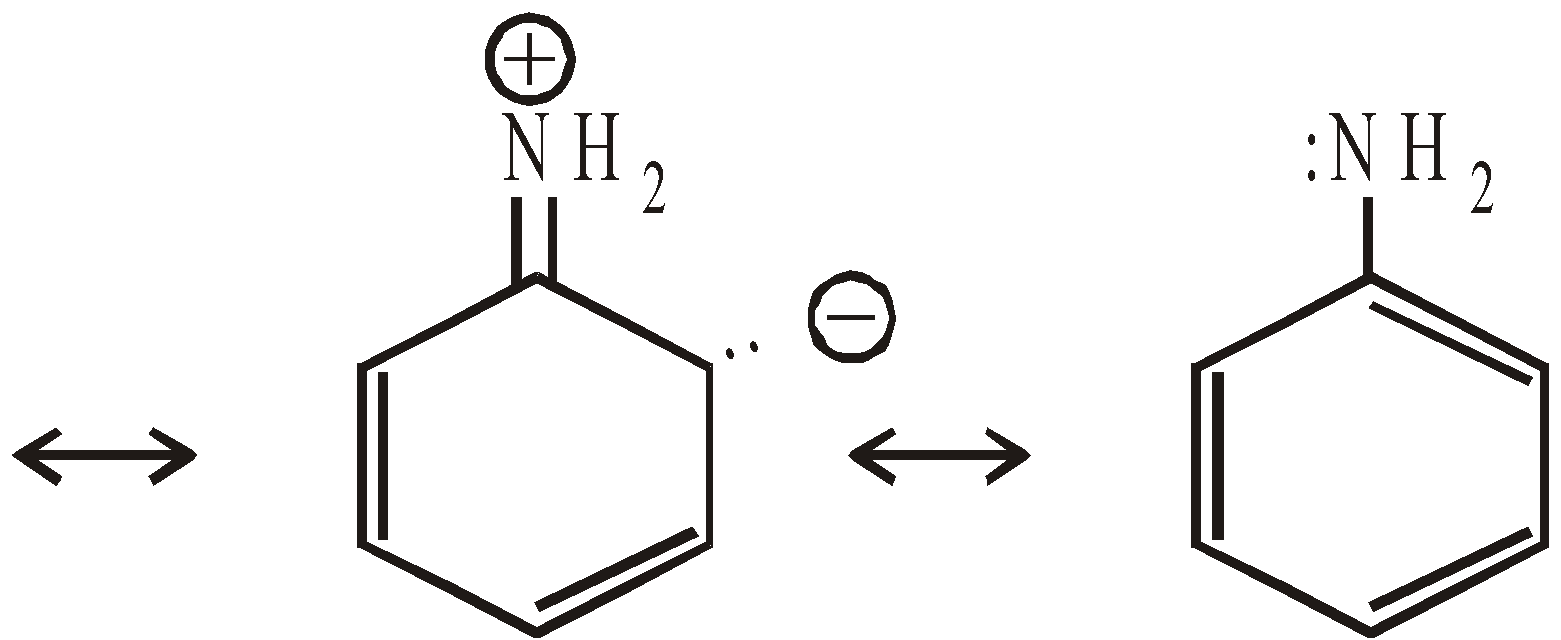
Aromatic amines are less basic than aliphatic amines
organic-chemistry-some-basic-principles-and-technique-neet-coaching-delhi-tuition-class-11-chemistryorganic-chemistry-some-basic-principles-and-technique-neet-coaching-delhi-tuition-class-11-chemistry
Due to resonance the unshared pair of electrons present on nitrogen atom is delocalised within benzene nucleus and not available for protonation (to accept H+). Hence basic character is suppressed.

STABILITY OF CATIONS
Methoxy methyl cation is more stable by 76 kcal/mol than methyl Cation.
organic-chemistry-some-basic-principles-and-technique-neet-coaching-delhi-tuition-class-11-chemistry

UNEXPECTED ADDITION PRODUCTS
organic-chemistry-some-basic-principles-and-technique-neet-coaching-delhi-tuition-class-11-chemistryorganic-chemistry-some-basic-principles-and-technique-neet-coaching-delhi-tuition-class-11-chemistry

A is more stable than B
organic-chemistry-some-basic-principles-and-technique-neet-coaching-delhi-tuition-class-11-chemistry

RESONANCE AND BOND LENGTHS :
Benzene organic-chemistry-some-basic-principles-and-technique-neet-coaching-delhi-tuition-class-11-chemistry
Normal C – C = 1.54 Å, C = C = 1.34 Å,
All C – C bonds in benzene 1.39Å.
Carboxylate ion  organic-chemistry-some-basic-principles-and-technique-neet-coaching-delhi-tuition-class-11-chemistry
Normal C = O  = 1.22Å, C – O = 1.4Å,
All C – O bonds in carboxylate ion = 1.28Å
Nitro group    organic-chemistry-some-basic-principles-and-technique-neet-coaching-delhi-tuition-class-11-chemistry
Normal N – O = 1.36Å, N = O = 1.15Å
All N – O bonds in nitro group 1.21 – 1.23 Å

RESONANCE AND BOND ORDER
It is obtained by the following relation.
organic-chemistry-some-basic-principles-and-technique-neet-coaching-delhi-tuition-class-11-chemistry
organic-chemistry-some-basic-principles-and-technique-neet-coaching-delhi-tuition-class-11-chemistryion
organic-chemistry-some-basic-principles-and-technique-neet-coaching-delhi-tuition-class-11-chemistry
organic-chemistry-some-basic-principles-and-technique-neet-coaching-delhi-tuition-class-11-chemistryion
organic-chemistry-some-basic-principles-and-technique-neet-coaching-delhi-tuition-class-11-chemistry

RESONANCE AND DIPOLE MOMENT
Resonance affects the Dipole moment. D.M. of ethyl chloride is 2.05 Debye.
In vinyl chloride organic-chemistry-some-basic-principles-and-technique-neet-coaching-delhi-tuition-class-11-chemistry
organic-chemistry-some-basic-principles-and-technique-neet-coaching-delhi-tuition-class-11-chemistry
Inductive and resonance induced D.M. operate in opposite direction, hence value is 1.44 Debye.
In chlorobenzene Inductive and Resonance induced D.M. operate in opposite direction. organic-chemistry-some-basic-principles-and-technique-neet-coaching-delhi-tuition-class-11-chemistry
The value of DM is 1.55 Debye.

RESONANCE ENERGY (E)
It is given by the equation
ER = E0 – EC
ER = Resonance energy, E0 = Observed heat of formation and EC = Calculated heat of formation of the most stable of the resonating structures.
In case of unsaturated compounds, Resonance energy is the difference between a measured and calculated heat of hydrogenation e.g.,
organic-chemistry-some-basic-principles-and-technique-neet-coaching-delhi-tuition-class-11-chemistry
Calculated value of heat of hydrogenation of benzene
= 28.6 × 3 = 85.8 kcal/mol, RE = 36.0 kcal/mol.
The greater the RE, the more is the stability.

MESOMERIC EFFECT (ME)

It is a permanent effect and similar to electromeric effect.
Like Inductive effect it may be +ME or  –ME.

+ME atoms or groups donate electrons to the double bond or conjugated system e.g. –Cl, –Br, –I, NH2, –NHR, –NR2, –OH, –OR, –SH, –SR etc.

organic-chemistry-some-basic-principles-and-technique-neet-coaching-delhi-tuition-class-11-chemistry

–ME atoms or groups withdraw electrons eg. –NO2, CN, COOH, CHO, HSO3.

organic-chemistry-some-basic-principles-and-technique-neet-coaching-delhi-tuition-class-11-chemistry

CONJUGATION

The compounds containing alternate single and double bonds are known as conjugated compounds. Such compounds exhibit certain abnormal properties due to interaction between single and double bonds, known as conjugation

ABNORMAL ADDITION REACTIONS

Addition of HBr to 1,3-butadiene.

organic-chemistry-some-basic-principles-and-technique-neet-coaching-delhi-tuition-class-11-chemistry
organic-chemistry-some-basic-principles-and-technique-neet-coaching-delhi-tuition-class-11-chemistry     

EXTRA STABILITY

Each C-atom in 1, 3-butadiene is sp2 hybridised and contains one pz atomic orbital parallel to each other and perpendicular to the plane of hybrid atomic orbitals. By sidewise overlapping these pz atomic orbitals form a delocalised p molecular orbital which provides the extra stability to the molecule.

BOND LENGTH

Conjugation affects the bond length. The C2 – C3 bond length in 1,3-butadiene is 1.47 Å and C1 – C2 bond length is 1.35Å due to conjugation.

HEAT OF HYDROGENATION

Calculated heat of hydrogenation of 1,3 butadiene = 28.6 × 2 = 57.2 kcal.
Observed heat of hydrogenation of 1,3-butadiene = 53.7 kcal.
R.E. = 57.2 – 53.7 = 3.5 kcal/mole
Thus, due to conjugation 1,3-butadiene is stabilised by 3.5 kcal/mol.

HYPERCONJUGATION

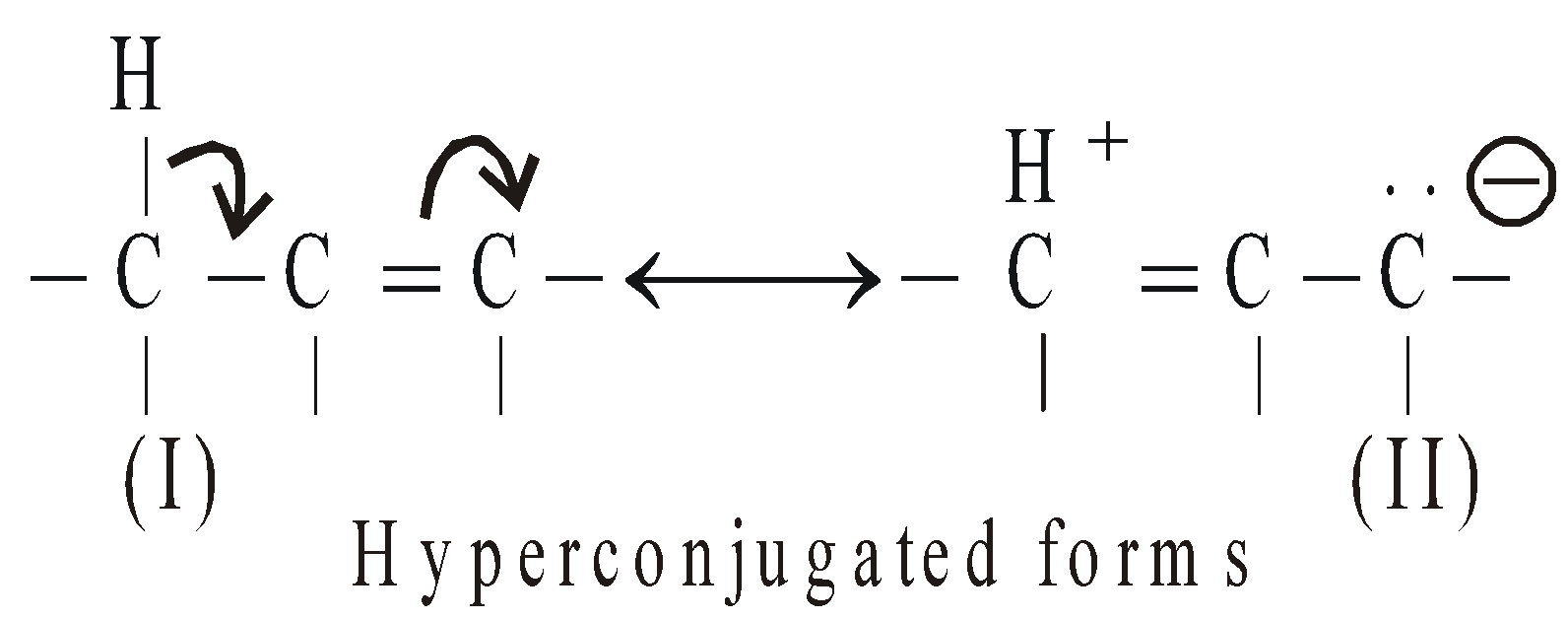
Introduced by Baker and Nathan (1935). The electron release by C–H bond by the effect similar to electromeric effect is known as hyperconjugation. It is a permanent effect.
organic-chemistry-some-basic-principles-and-technique-neet-coaching-delhi-tuition-class-11-chemistry
Since there is no apparent bond between C and H+, the hyperconjugation is also known as No bond Resonance. The magnitude of inductive effect and hyperconjugation follows the order.
organic-chemistry-some-basic-principles-and-technique-neet-coaching-delhi-tuition-class-11-chemistry
Increasing Inductive Effect

EFFECTS OF HYPERCONJUGATION

HEAT OF HYDROGENATION OF SUBSTITUTED OLEFINS :
The greater the number of H.C. forms the more is the stability.
Compound Heat of hydrogenation
CH2 = CH2 Ethylene 32.8 kcal/mol
CH3–CH = CH2 Propylene 30.1 kcal/mol
(Due to H.C. forms)

organic-chemistry-some-basic-principles-and-technique-neet-coaching-delhi-tuition-class-11-chemistry   Tetramethyl ethylene 26.6 kcal mol.

BOND LENGTHS
Dimethyl acetylene
organic-chemistry-some-basic-principles-and-technique-neet-coaching-delhi-tuition-class-11-chemistry
Normal C–C = 1.54Å; C1 – C2 = 1.46Å

HYPERCONJUGATION AND DIPOLE MOMENT
Calculated dipole moment of nitro methane is 2.59 Debye and the observed value is 3.15 Debye.
organic-chemistry-some-basic-principles-and-technique-neet-coaching-delhi-tuition-class-11-chemistry

CLEAVAGE OF COVALENT BOND

HETEROLYTIC CLEAVAGE / HETEROLYSIS
shared pair of electrons is retained by one atom
organic-chemistry-some-basic-principles-and-technique-neet-coaching-delhi-tuition-class-11-chemistry
or organic-chemistry-some-basic-principles-and-technique-neet-coaching-delhi-tuition-class-11-chemistry
Species carrying negative charge are known as anions; they are rich in electrons hence nucleophilic in nature. In a chemical reaction such species always attack at the point of low electron density. Species carrying positive charge are known as cations, they are electrons deficient hence electrophilic in nature. In a chemical reaction they attack at the point of high electron density.

HOMOLYTIC CLEAVAGE / HOMOLYSIS
The atoms retain one electron each.
organic-chemistry-some-basic-principles-and-technique-neet-coaching-delhi-tuition-class-11-chemistry
The resulting species are neutral, contain at least one unpaired electron hence known as free radicals, electron deficient hence electrophilic in nature, very reactive, paramagnetic in nature, hydrogen abstractor. Homolytic cleavage usually occurs in non polar bonds at high temperature or in presence of UV radiations.

TYPES OF REAGENTS

ELECTROPHILIC REAGENTS
They have high affinity for electrons
organic-chemistry-some-basic-principles-and-technique-neet-coaching-delhi-tuition-class-11-chemistry
They may be neutral in nature also AlCl3, BF3, ZnCl2, FeCl3, SnCl4 etc.

NUCLEOPHILIC REAGENTS
Electron rich species and have affinity towards nucleus (which is positively charged).
organic-chemistry-some-basic-principles-and-technique-neet-coaching-delhi-tuition-class-11-chemistry
Neutral nucleophiles are capable of donating a pair of electrons e.g.
organic-chemistry-some-basic-principles-and-technique-neet-coaching-delhi-tuition-class-11-chemistry
Nucleophilicity is defined by the rate of attack on an electrophilic carbon atom.
  • Species with negative charge are stronger nucleophiles than analogous species without a negative charge
organic-chemistry-some-basic-principles-and-technique-neet-coaching-delhi-tuition-class-11-chemistry
  • Nucleophilicity decreases from left to right across the periodic table
organic-chemistry-some-basic-principles-and-technique-neet-coaching-delhi-tuition-class-11-chemistry
  • Nucleophilicity increases down the periodic table
organic-chemistry-some-basic-principles-and-technique-neet-coaching-delhi-tuition-class-11-chemistry

REACTION INTERMEDIATES

CARBOCATIONS (CARBONIUM IONS)organic-chemistry-some-basic-principles-and-technique-neet-coaching-delhi-tuition-class-11-chemistry

These are the species carrying positive charge on the carbon atom, which is sp2 hybridised, with planar structure. The vacant p-orbital lies perpendicular to the plane of the other atoms. They are strong electrophiles. They are stabilised by alkyl substituents by
INDUCTIVE EFFECT
organic-chemistry-some-basic-principles-and-technique-neet-coaching-delhi-tuition-class-11-chemistry

HYPERCONJUGATION
Partial overlapping of filled orbitals with empty ones

organic-chemistry-some-basic-principles-and-technique-neet-coaching-delhi-tuition-class-11-chemistryorganic-chemistry-some-basic-principles-and-technique-neet-coaching-delhi-tuition-class-11-chemistry

RESONANCE STABILISATION
Unsaturated carbocations are stabilised by Resonance. e.g.
Allyl Carbonium ion    
organic-chemistry-some-basic-principles-and-technique-neet-coaching-delhi-tuition-class-11-chemistry
Benzyl Carbonium ion
organic-chemistry-some-basic-principles-and-technique-neet-coaching-delhi-tuition-class-11-chemistry           
The order of stability of different carbonium ions
organic-chemistry-some-basic-principles-and-technique-neet-coaching-delhi-tuition-class-11-chemistry
 
REACTIONS OF CARBOCATIONS
  • Combination with a nucleophile
organic-chemistry-some-basic-principles-and-technique-neet-coaching-delhi-tuition-class-11-chemistry
  • Elimination of Proton
organic-chemistry-some-basic-principles-and-technique-neet-coaching-delhi-tuition-class-11-chemistry
  • Rearrangement
If 1,2-shift of hydrogen or alkyl can form a more stable carbocation, then such a rearrangement takes place
organic-chemistry-some-basic-principles-and-technique-neet-coaching-delhi-tuition-class-11-chemistryorganic-chemistry-some-basic-principles-and-technique-neet-coaching-delhi-tuition-class-11-chemistry

CARBANIONS (CARBO ANIONS)organic-chemistry-some-basic-principles-and-technique-neet-coaching-delhi-tuition-class-11-chemistry

The species carrying negative charge on the carbon atom which is sp3 hybridised and tetrahedral. They are nucleophilic in nature and their structure resembles an amine. The stability order is

INDUCTIVE EFFECT
organic-chemistry-some-basic-principles-and-technique-neet-coaching-delhi-tuition-class-11-chemistry
+ I effect of R increases electron density on C making it less stable.

RESONANCE STABILISATION
Allyl Carbanion
organic-chemistry-some-basic-principles-and-technique-neet-coaching-delhi-tuition-class-11-chemistry
Benzyl Carbanion
organic-chemistry-some-basic-principles-and-technique-neet-coaching-delhi-tuition-class-11-chemistry
Resonance stabilisation is more effective than other factors.
organic-chemistry-some-basic-principles-and-technique-neet-coaching-delhi-tuition-class-11-chemistry

FREE RADICALSorganic-chemistry-some-basic-principles-and-technique-neet-coaching-delhi-tuition-class-11-chemistry

They are sp2 hybridised and planar. The perpendicular p-orbital contains an odd electron. They lack in octet hence electrophilic in nature. The order of stability is

INDUCTIVE EFFECT
organic-chemistry-some-basic-principles-and-technique-neet-coaching-delhi-tuition-class-11-chemistry

NO BOND RESONANCE STABILISATION / HYPERCONJUGATION
organic-chemistry-some-basic-principles-and-technique-neet-coaching-delhi-tuition-class-11-chemistryorganic-chemistry-some-basic-principles-and-technique-neet-coaching-delhi-tuition-class-11-chemistry

RESONANCE STABILISATION
Allyl free radical
organic-chemistry-some-basic-principles-and-technique-neet-coaching-delhi-tuition-class-11-chemistry
Benzyl free radical
organic-chemistry-some-basic-principles-and-technique-neet-coaching-delhi-tuition-class-11-chemistryorganic-chemistry-some-basic-principles-and-technique-neet-coaching-delhi-tuition-class-11-chemistry
Order of stability of various free radicals organic-chemistry-some-basic-principles-and-technique-neet-coaching-delhi-tuition-class-11-chemistry      organic-chemistry-some-basic-principles-and-technique-neet-coaching-delhi-tuition-class-11-chemistry

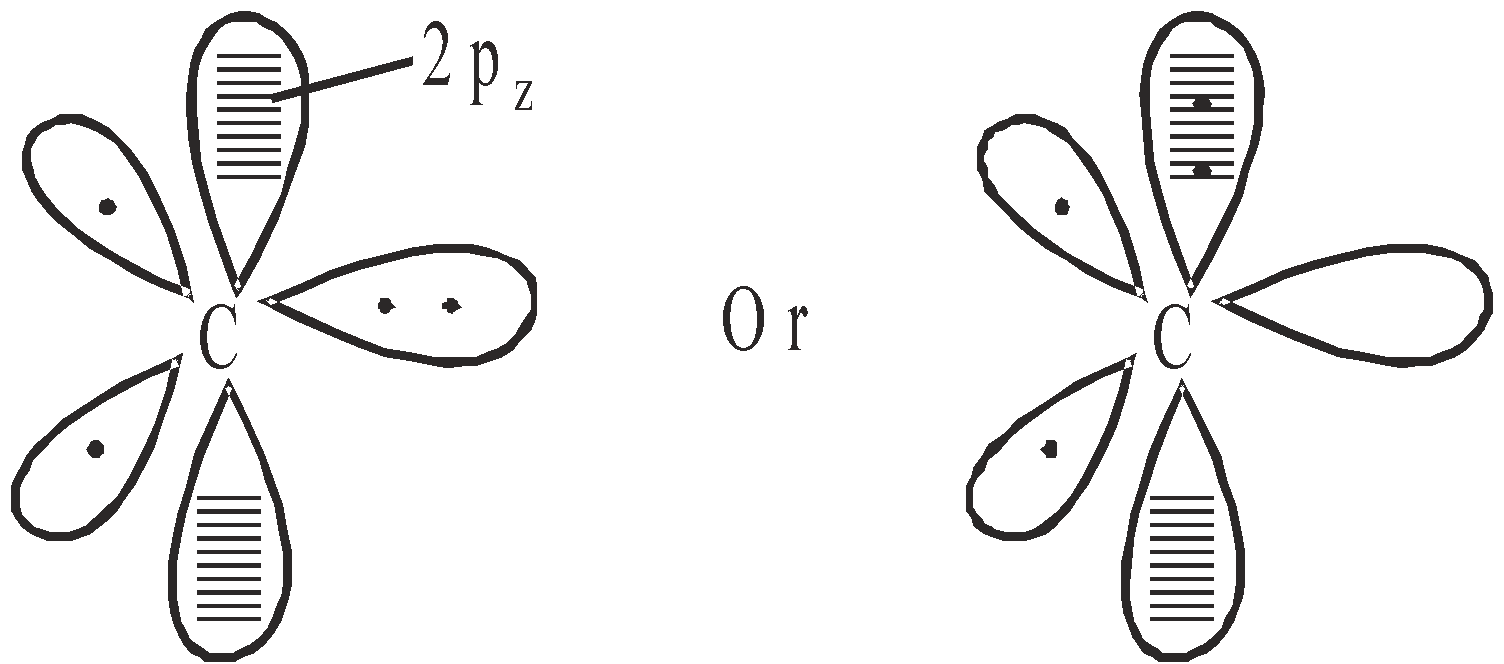
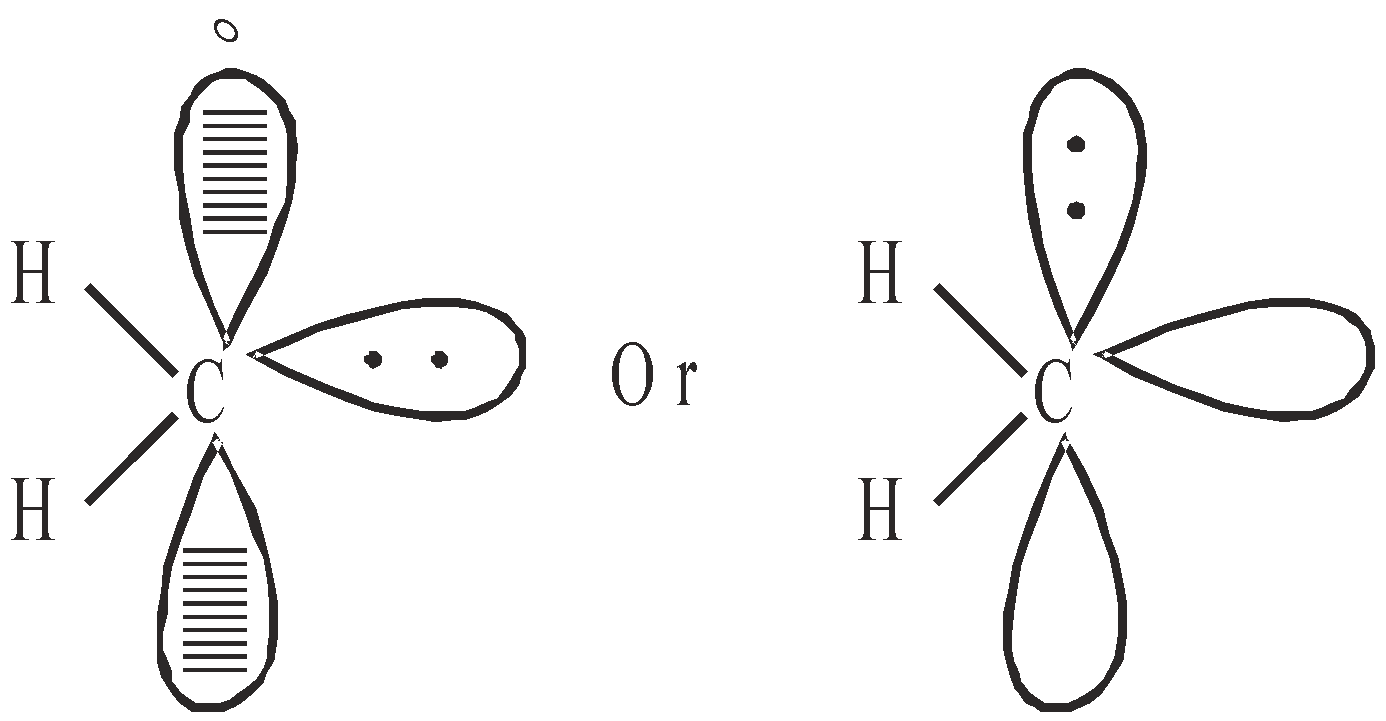
CARBENES R=C:

These are uncharged reactive intermediates that contain a divalent carbon atom which is sp2 hybridised. There is a perpendicular vacant p-orbital.

GENERATION

  • organic-chemistry-some-basic-principles-and-technique-neet-coaching-delhi-tuition-class-11-chemistry
  • organic-chemistry-some-basic-principles-and-technique-neet-coaching-delhi-tuition-class-11-chemistry
  • organic-chemistry-some-basic-principles-and-technique-neet-coaching-delhi-tuition-class-11-chemistry

SINGLET CARBENES
organic-chemistry-some-basic-principles-and-technique-neet-coaching-delhi-tuition-class-11-chemistry
Multiplicity is A = 2s + 1 = 2 × 0 + 1 = 1
organic-chemistry-some-basic-principles-and-technique-neet-coaching-delhi-tuition-class-11-chemistry

TRIPLET CARBENES
organic-chemistry-some-basic-principles-and-technique-neet-coaching-delhi-tuition-class-11-chemistry
Multiplicity is A = 2 × 1 + 1 = 3   
organic-chemistry-some-basic-principles-and-technique-neet-coaching-delhi-tuition-class-11-chemistry
Triplet is more stable than singlet.

NITRENESorganic-chemistry-some-basic-principles-and-technique-neet-coaching-delhi-tuition-class-11-chemistry

Nitrenes are nitrogen analogs of carbenes, nitrogen is sp2 hybridised.
GENERATION
organic-chemistry-some-basic-principles-and-technique-neet-coaching-delhi-tuition-class-11-chemistry
SINGLET
organic-chemistry-some-basic-principles-and-technique-neet-coaching-delhi-tuition-class-11-chemistry
Multiplicity A = 2s + 1  = 2 × 0 + 1 = 1
TRIPLET
organic-chemistry-some-basic-principles-and-technique-neet-coaching-delhi-tuition-class-11-chemistry
Multiplicity A = 2s + 1 = 2 × 1 + 1 = 3

ARYNES

The derivatives of benzyne are called arynes :
organic-chemistry-some-basic-principles-and-technique-neet-coaching-delhi-tuition-class-11-chemistry

GENERATION
organic-chemistry-some-basic-principles-and-technique-neet-coaching-delhi-tuition-class-11-chemistry

TYPES OF REACTIONS

SUBSTITUTION REACTIONS OR REPLACEMENT REACTIONS

organic-chemistry-some-basic-principles-and-technique-neet-coaching-delhi-tuition-class-11-chemistry: SUBSTITUTION NUCLEOPHILIC UNIMOLECULAR REACTIONS
Such reactions take place in two stages
organic-chemistry-some-basic-principles-and-technique-neet-coaching-delhi-tuition-class-11-chemistry

organic-chemistry-some-basic-principles-and-technique-neet-coaching-delhi-tuition-class-11-chemistry : SUBSTITUTION NUCLEOPHILIC BIMOLECULAR REACTIONS
organic-chemistry-some-basic-principles-and-technique-neet-coaching-delhi-tuition-class-11-chemistry
Strength of nucleophile not important
Strong nucleophiles required
Good ionising solvent required
May go faster in less polar solvent
Rate = K [RX]
Rate  = K [RX] [Nu]
Possible rearrangements
No rearrangements
Lead to racemisation
Lead to inversion.

organic-chemistry-some-basic-principles-and-technique-neet-coaching-delhi-tuition-class-11-chemistry: SUBSTITUTION NUCLEOPHILIC INTERNAL REACTIONS
organic-chemistry-some-basic-principles-and-technique-neet-coaching-delhi-tuition-class-11-chemistry

ELIMINATION REACTIONS

E1 : ELIMINATION UNIMOLECULAR
organic-chemistry-some-basic-principles-and-technique-neet-coaching-delhi-tuition-class-11-chemistry

E2 : BIMOLECULAR ELIMINATION
organic-chemistry-some-basic-principles-and-technique-neet-coaching-delhi-tuition-class-11-chemistry
E1
E2
Good ionising solvent required
Solvent polarity not so important
Base strength not important
Strong bases are required
Rate = K [RX]
Rate  = K [RX] [B]
Saytzeff orientation
Rearrangements are common
No rearrangements

ADDITION REACTIONS

ELECTROPHILIC ADDITION REACTIONS, initiation by electrophile e.g.
organic-chemistry-some-basic-principles-and-technique-neet-coaching-delhi-tuition-class-11-chemistry
NUCLEOPHILIC ADDITION REACTIONS, initiation by nucleophile e.g.

organic-chemistry-some-basic-principles-and-technique-neet-coaching-delhi-tuition-class-11-chemistry
FREE RADICAL ADDITION REACTIONS, initiation by free radical
organic-chemistry-some-basic-principles-and-technique-neet-coaching-delhi-tuition-class-11-chemistry

REARRANGEMENT REACTIONS

organic-chemistry-some-basic-principles-and-technique-neet-coaching-delhi-tuition-class-11-chemistry

POLYMERISATION REACTIONS

organic-chemistry-some-basic-principles-and-technique-neet-coaching-delhi-tuition-class-11-chemistry

DIRECTIVE INFLUENCE OF ATOMS AND GROUPS

(For electrophilic substitution reactions)

When monosubstitution product of benzene is converted into di-substitution product, the position of second incoming group is decided by the atom or group already present in the benzene nucleus. This is known as directive influence of atoms and groups.

Directive influence is governed by three effects :
  • Inductive effect (I)
  • Electromeric effect (E)
  • Resonance (M)

Any effect that pushes the electrons towards the benzene nucleus is taken as positive and activates the benzene nucleus for further substitution. The effect that pushes the electrons away from benzene nucleus is taken as negative and deactivates the benzene nucleus for further substitution.

Here we will consider Inductive effect and Mesomeric effect (Resonance) to decide the directive influence of atoms and groups. The electromeric effect is similar to Mesomeric effect and always operate in the same direction, the only difference is the former is temporary and latter is permanent.

DIRECTIVE INFLUENCE OF OH GROUP

INDUCTIVE EFFECT (I)
organic-chemistry-some-basic-principles-and-technique-neet-coaching-delhi-tuition-class-11-chemistry
MESOMERIC EFFECT (M)
organic-chemistry-some-basic-principles-and-technique-neet-coaching-delhi-tuition-class-11-chemistry
Ortho and para positions become the points of high electron density as + M > > – I. The electrophilic reagent will attack at o- and p- positions. Hence OH gp. is o, p-directing in nature with activation of benzene nucleus.
Other examples areorganic-chemistry-some-basic-principles-and-technique-neet-coaching-delhi-tuition-class-11-chemistry

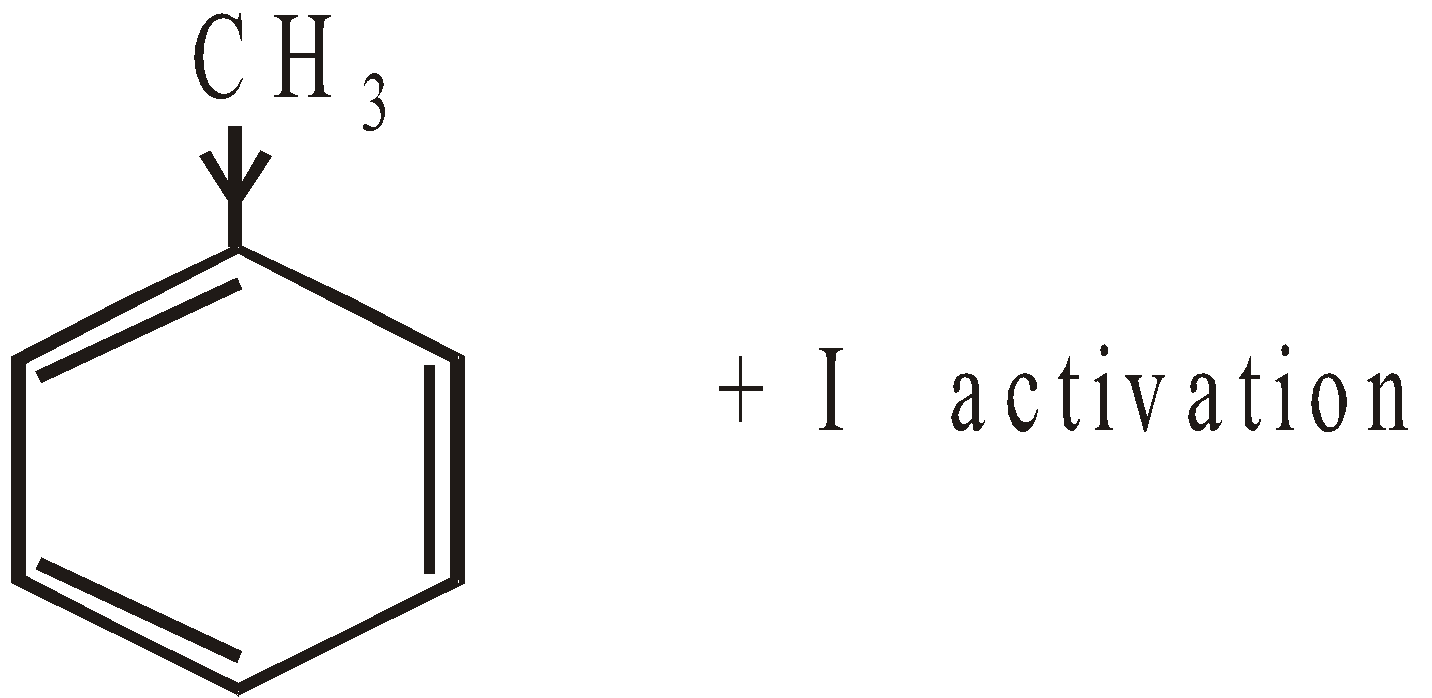
DIRECTIVE INFLUENCE OF –CH3GROUP

INDUCTIVE EFFECT (I)
organic-chemistry-some-basic-principles-and-technique-neet-coaching-delhi-tuition-class-11-chemistry
HYPERCONJUGATION (HC)
organic-chemistry-some-basic-principles-and-technique-neet-coaching-delhi-tuition-class-11-chemistry
The o, p-positions become the points of high electron density. The electrophilic reagent will attack at o- and p- positions. Hence methyl group is o,p-directing in nature with activation of benzene nucleus.
Other examples are :  etc.

DIRECTIVE INFLUENCE OF –CN GROUP :

INDUCTIVE EFFECT (I)
organic-chemistry-some-basic-principles-and-technique-neet-coaching-delhi-tuition-class-11-chemistry
MESOMERIC EFFECT (M)
organic-chemistry-some-basic-principles-and-technique-neet-coaching-delhi-tuition-class-11-chemistry
The o,p-positions become the points of low electron density, therefore the electrophilic reagent will attack at the m position. Hence CN is meta directing in nature with deactivation of benzene nucleus.
Other examples are : organic-chemistry-some-basic-principles-and-technique-neet-coaching-delhi-tuition-class-11-chemistry

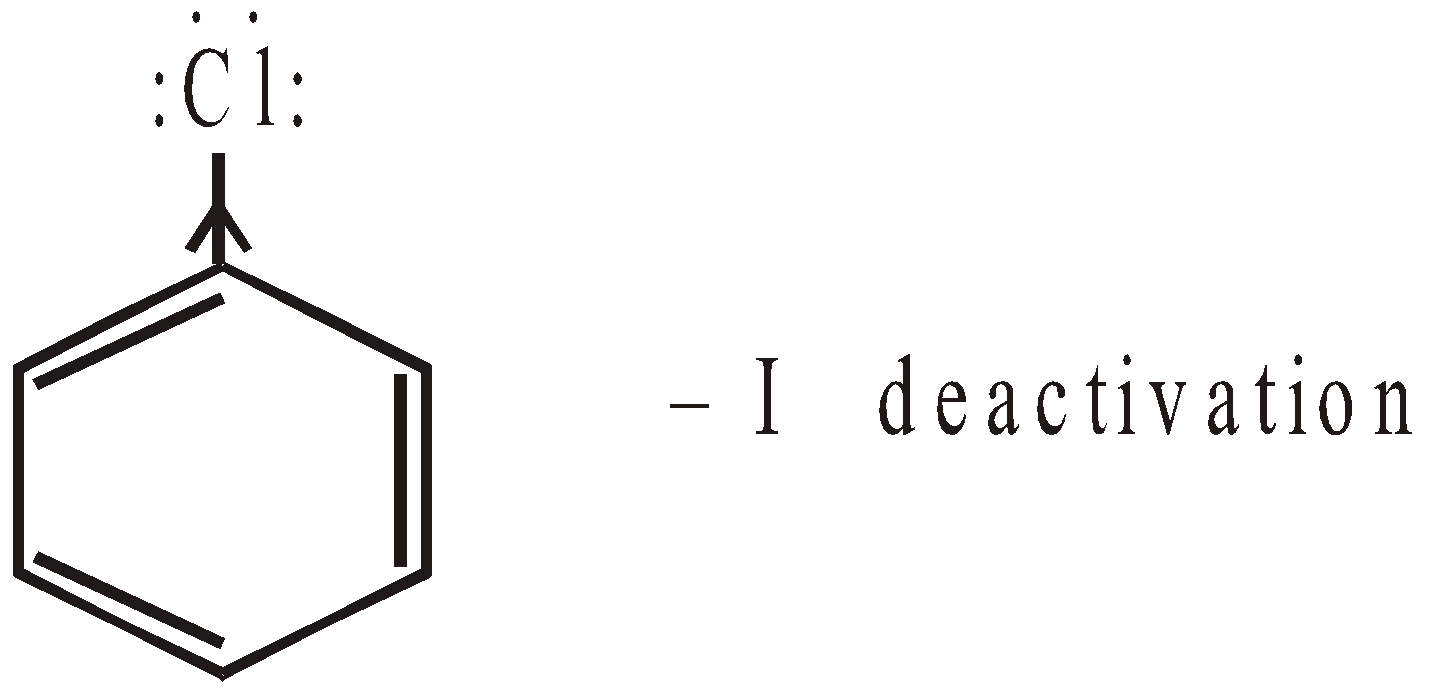
DIRECTIVE INFLUENCE OF –CL ATOM

INDUCTIVE EFFECT (I)
organic-chemistry-some-basic-principles-and-technique-neet-coaching-delhi-tuition-class-11-chemistry
MESOMERIC EFFECT (M)
organic-chemistry-some-basic-principles-and-technique-neet-coaching-delhi-tuition-class-11-chemistry
By mesomeric effect the o,p positions become the points of high electron density. Further –I > +M, hence Cl is o, p directing in nature with deactivation of benzene nucleus.
Other examples are : –F, Br, I

EASE OF ELECTROPHILIC SUBSTITUTION OF BENZENE AND ITS DERIVATIVES

  • Strongly activating (o, p directing)
organic-chemistry-some-basic-principles-and-technique-neet-coaching-delhi-tuition-class-11-chemistry
  • Moderately activating (o, p directing)
organic-chemistry-some-basic-principles-and-technique-neet-coaching-delhi-tuition-class-11-chemistry
  • Weakly activating (o, p-directing)
organic-chemistry-some-basic-principles-and-technique-neet-coaching-delhi-tuition-class-11-chemistry
  • Benzene itself.
  • Deactivating (o, p - directing) : F, Cl, Br, I
  • Deactivating (m-directing) :             
organic-chemistry-some-basic-principles-and-technique-neet-coaching-delhi-tuition-class-11-chemistry
Again,organic-chemistry-some-basic-principles-and-technique-neet-coaching-delhi-tuition-class-11-chemistry

COMMON ELECTROPHILIC SUBSTITUTION REACTIONS

  • Nitration
organic-chemistry-some-basic-principles-and-technique-neet-coaching-delhi-tuition-class-11-chemistry
Electrophile organic-chemistry-some-basic-principles-and-technique-neet-coaching-delhi-tuition-class-11-chemistry
  • Sulphonation
organic-chemistry-some-basic-principles-and-technique-neet-coaching-delhi-tuition-class-11-chemistry
Electrophile organic-chemistry-some-basic-principles-and-technique-neet-coaching-delhi-tuition-class-11-chemistry or  SO3
  • Halogenation
organic-chemistry-some-basic-principles-and-technique-neet-coaching-delhi-tuition-class-11-chemistry
Electrophile organic-chemistry-some-basic-principles-and-technique-neet-coaching-delhi-tuition-class-11-chemistry
  • Friedel Craft's alkylation  
organic-chemistry-some-basic-principles-and-technique-neet-coaching-delhi-tuition-class-11-chemistry
Electrophile R+
  • Friedel crafts acylation
organic-chemistry-some-basic-principles-and-technique-neet-coaching-delhi-tuition-class-11-chemistry
 Electrophile organic-chemistry-some-basic-principles-and-technique-neet-coaching-delhi-tuition-class-11-chemistry

NUCLEOPHILIC SUBSTITUTION OF BENZENE  

It does not occur with benzene itself, but it does occur with some substituted benzenes.
organic-chemistry-some-basic-principles-and-technique-neet-coaching-delhi-tuition-class-11-chemistry organic-chemistry-some-basic-principles-and-technique-neet-coaching-delhi-tuition-class-11-chemistry

H much less stable hence some oxidising reagent with which H can react facilitate the nucleophilic substitution.

Notes For Class 11 Chemistry Janakpuri, Delhi-Biology Class 11 Notes, Chemistry Class 11 Notes, Chemistry Notes for Class 11, Chemistry Notes for Class 11, Notes For Chemistry Class 11, Chemistry lectures Class 11, Chemistry classroom lectures Class 11, best Chemistry Notes for Class 11, best Chemistry lectures for Class 11, grade 11 Chemistry Notess, Class 11 Chemistry chapter 1 Notes, Class 11 Chemistry chapter 2 Notes, Class 11 Chemistry chapter 3 Notes, Chemistry Class 11 Notes free download, Chemistry Class 11 animation Notes, animation Notes for Class 11, neet, science, coaching classes, tutors, competitive exam preparation, study center, learning center, best coaching, top coaching, online coaching, offline coaching, Study Material, Books, DVDs, Notes

Want to know more

Please fill in the details below:

Name

Admissions,1,Alternating Current,60,AP EAMCET 2020,1,Basic Maths,2,BCECE 2020,1,best books for iit jee,2,best coaching institute for iit,1,best coaching institute for iit jee preparation,1,best iit jee coaching delhi,1,best iit jee coaching in delhi,2,best study material for iit jee,4,BITSAT Registration 2020,1,Blog,62,books for jee preparation,1,books recommended by iit toppers,3,Capacitance,3,CBSE,1,CBSE accounts exam,1,CBSE boards,1,CBSE NEET,9,cbse neet 2019,3,CBSE NEET 2020,1,cbse neet nic,1,Centre of Mass,2,Chemistry,58,Class 11 Chemistry,15,coaching for jee advanced,1,coaching institute for iit jee,2,Collision,2,COMEDK UGET 2020 Application Form,1,COMEDK UGET 2020 Exam Form,1,COMEDK UGET news,1,CUCET 2020,2,Current Electricity,4,CVR college,1,Digestion and Absorption Notes PDF,1,Electromagnetic Induction,3,Electronics,1,Electrostatics,3,Energy,1,Engineering & Medical,1,Fluid Mechanics,4,Gravitation,2,GUJCET 2020 Application Form,1,Heat,4,iit admission,1,iit advanced,1,iit coaching centre,3,iit coaching centre in delhi,2,iit coaching classes,2,iit coaching in delhi,1,iit coaching institute in delhi,1,iit entrance exam,1,iit entrance exam syllabus,2,iit exam pattern,2,iit jee,5,iit jee 2019,3,iit jee advanced,2,iit jee books,3,iit jee coaching,2,iit jee exam,3,iit jee exam 2019,1,iit jee exam pattern,3,iit jee institute,1,iit jee main 2019,2,iit jee mains,3,iit jee mains syllabus,2,iit jee material,1,iit jee online test,3,iit jee practice test,3,iit jee preparation,6,iit jee preparation in delhi,2,iit jee preparation time,1,iit jee preparation tips by toppers,2,iit jee question paper,1,iit jee study material,3,iit jee study materials,2,iit jee syllabus,2,iit jee syllabus 2019,2,iit jee test,3,iit preparation,2,iit preparation books,5,iit preparation time table,2,iit preparation tips,2,iit syllabus,2,iit test series,3,IITJEE,100,Important Chemistry Notes for NEET Preparation,1,IPU CET,1,JEE Advanced,83,jee advanced exam,2,jee advanced exam pattern,1,jee advanced paper,1,JEE Books,1,JEE Coaching Delhi,3,jee exam,3,jee exam 2019,6,JEE Exam Pattern,2,jee exam pattern 2019,1,jee exam preparation,1,JEE Main,85,jee main 2019,4,JEE Main 2020,1,JEE Main 2020 Application Form,2,JEE Main 2020 news,2,JEE Main 2020 Official Answer Key,1,JEE Main 2020 Registration,1,JEE Main 2020 Score,1,JEE Main application form,1,jee main coaching,1,JEE Main eligibility criteria,3,jee main exam,1,jee main exam 2019,3,jee main online question paper,1,jee main online test,3,JEE Main Paper-2 Result,1,jee main registration,2,jee main syllabus,2,JEE mains 2020,1,jee mains question bank,1,jee mains test papers,3,JEE Mock Test,2,jee notes,1,jee past papers,1,JEE Preparation,2,jee preparation in delhi,1,jee preparation material,4,JEE Study Material,1,jee syllabus,6,JEE Syllabus Chemistry,1,JEE Syllabus Maths,1,JEE Syllabus Chemistry,1,jee test series,3,KCET - 2020,1,Kinematics,1,Latest article,5,Latest Articles,61,Latest News,34,latest news about neet exam,1,Laws of Motion,2,Magnetic Effect of Current,3,Magnetism,3,MHT CET 2020,2,MHT CET 2020 exam schedule,1,Modern Chemistry,1,NCERT Solutions,15,neet,3,neet 2019,1,neet 2019 eligibility criteria,1,neet 2019 exam date,2,neet 2019 test series,2,NEET 2020,2,NEET 2020 Application Form,1,NEET 2020 Eligibility Criteria,1,NEET 2020 Registration,1,neet application form,1,neet application form 2019 last date,1,Neet Chemistry Syllabus,1,Neet Books,3,neet eligibility criteria,3,neet exam 2019,7,neet exam application,1,neet exam date,1,neet exam details,1,neet exam pattern,6,neet exam pattern 2019,2,neet examination,1,neet mock test 2019,1,Neet Notes,3,Neet Online Application Form,3,neet online test,2,neet past papers,1,neet Chemistry syllabus,1,neet practice test,2,NEET preparation books,1,neet qualification marks,1,NEET question paper 2019,1,neet question papers,1,neet registration,1,Neet Study Material,3,neet syllabus,6,neet syllabus 2019,5,NEET Syllabus 2020,1,neet syllabus Chemistry,1,neet syllabus for Chemistry,1,neet syllabus for Chemistry,1,neet test series,1,neet ug 2019,2,news,5,online study material for iit jee,1,Optical Instruments,1,Chemistry,110,Chemistry books for iit jee,1,Power,1,Practical Chemistry,1,Quiz,5,Ray Optics,1,Rotational Motion,3,SHM,3,Simple Harmonic Motion,3,study materials for iit jee,1,Study Notes,110,study notes for iit jee,1,Thermodynamics,4,TS EAMCET Notification,2,Units and Dimensions,1,UPSEE 2020,1,UPSEE 2020 Application Form,2,UPSEE EXAM,1,Vectors,2,VITEE Application form,1,Wave Motion,3,Wave Optics,1,WBJEE 2020 Admit Card,1,WBJEE 2020 Answer Key,1,Work,1,
ltr
item
BEST NEET COACHING CENTER | BEST IIT JEE COACHING INSTITUTE | BEST NEET & IIT JEE COACHING: Organic Chemistry: Some Basic Principles And Techniques | Chemistry Notes for IITJEE/NEET
Organic Chemistry: Some Basic Principles And Techniques | Chemistry Notes for IITJEE/NEET
https://drive.google.com/thumbnail?id=1RBShNwZNA7H5_QhTsiZyutKRTJ916Khy&sz=s800
https://drive.google.com/thumbnail?id=1RBShNwZNA7H5_QhTsiZyutKRTJ916Khy&sz=s800=s72-c
BEST NEET COACHING CENTER | BEST IIT JEE COACHING INSTITUTE | BEST NEET & IIT JEE COACHING
https://www.Neetbharath.in/2019/05/Chemistry-notes-physical-world.html
https://www.Neetbharath.in/
https://www.Neetbharath.in/2019/05/Chemistry-notes-physical-world.html
true
7783647550433378923
UTF-8
Organic Chemistry: Some Basic Principles And Techniques: Online Neet Class-11 Chemistry Notes Janakpuri | Best Digital Neet Coaching Janakpuri, West Delhi | Online Neet Coaching Centers in Janakpuri, Delhi | Online Neet exams tuitions in Janakpuri | Experienced teachers of Chemistry to help Online Neet aspirants | Online Neet exams | Online Neet exam date | Online Neet exam Chemistry syllabus | Online Neet exam Chemistry syllabus | Online Neet exam Chemistry syllabus | Online Neet exam syllabus, date, criteria and pattern | best books for Online Neet exam Janakpuri, West Delhi | best online coaching for Online Neet exam Janakpuri, West Delhi | best study material for Online Neet exam Janakpuri, West Delhi | Online Neet exam centre in Janakpuri, West Delhi | Online Neet audio video lectures Janakpuri, West Delhi | Online Neet videos Janakpuri, West Delhi | Online Neet classroom videos Mayapuri, West Delhi | Online Neet question papers Mangolpuri, West Delhi | Online Neet test series papers with solutions Saraswati Vihar, West Delhi | Online Neet previous years question sample papers Peeragarhi, West Delhi | how to crack Online Neet exams Palam Colony, West Delhi | Online Neet exam duration Paschim Vihar, West Delhi | Online Neet exam eligibility criteria Budh Vihar, West Delhi | Online CBSE School Class 11 Science subject study material Janakpuri, West Delhi | Online CBSE School Class 11 Science subject study material Janakpuri A/B/C/D Block, West Delhi | Online CBSE School Class 11 Chemistry subject study material Janakpuri East-West Metro Station, West Delhi | Online CBSE School Class 11 Chemistry subject study material Janakpuri, West Delhi | Online CBSE School Class 11 Chemistry subject study material Dabri Mor, West Delhi | Online CBSE School Class 11 Chemistry subject study material Tilak Nagar, West Delhi | Online CBSE School Class 11 Chemistry subject study material Sagar Pur, West Delhi | Online CBSE School Class 11 Chemistry subject study material Uttam Nagar, West Delhi | Online CBSE School Class 11 Chemistry video lectures Vikaspuri, West Delhi | Online CBSE School Class 11 Chemistry video lectures Hari Nagar, West Delhi | Online CBSE School Class 11 Chemistry video lectures Dwarka sector 4/6/7/12/22/10/23/dwarka mor, West Delhi | Online CBSE School Class 11 Chemistry video lectures Subhash Nagar, West Delhi | Online CBSE School Class 11 Chemistry video lectures Kirti Nagar, West Delhi | Online CBSE School Class 11 Chemistry video lectures Rajouri Garden, West Delhi | Online CBSE School Class 11 Chemistry sample question papers Moti Nagar, West Delhi | Online CBSE School Class 11 Chemistry sample question papers Najafgarh, West Delhi | Online CBSE School Class 11 Chemistry sample question papers Virender Nagar, West Delhi | Online CBSE School Class 11 Chemistry sample question papers Punjabi Bagh, West Delhi | Online CBSE School Class 11 Chemistry sample question papers Rohini sec 9/3/24/11/7/8/16, West Delhi | Online CBSE School Class 11 Chemistry sample question papers Pitampura, West Delhi | Janakpuri A/B/C/D Block | Janakpuri East-West Metro Station | Dabri Mor | Tilak Nagar | Sagar Pur | Uttam Nagar | Vikaspuri | Hari Nagar | Dwarka sector 4/6/7/12/22/10/23/dwarka mor | Subhash Nagar | Kirti Nagar | Rajouri Garden | Moti Nagar | Najafgarh | Virender Nagar | Punjabi Bagh | Rohini sec 9/3/24/11/7/8/16 | Pitampura | Budh Vihar | Paschim Vihar | Palam Colony | Peeragarhi | Saraswati Vihar | Mangolpuri | Mayapuri.

NEET Previous Year Sample Papers


error: Content is protected !!